2 Reasons Work Should Be Fun, and 1 Way to Make It Fun: Bree Groff, Workplace Consultant and Author
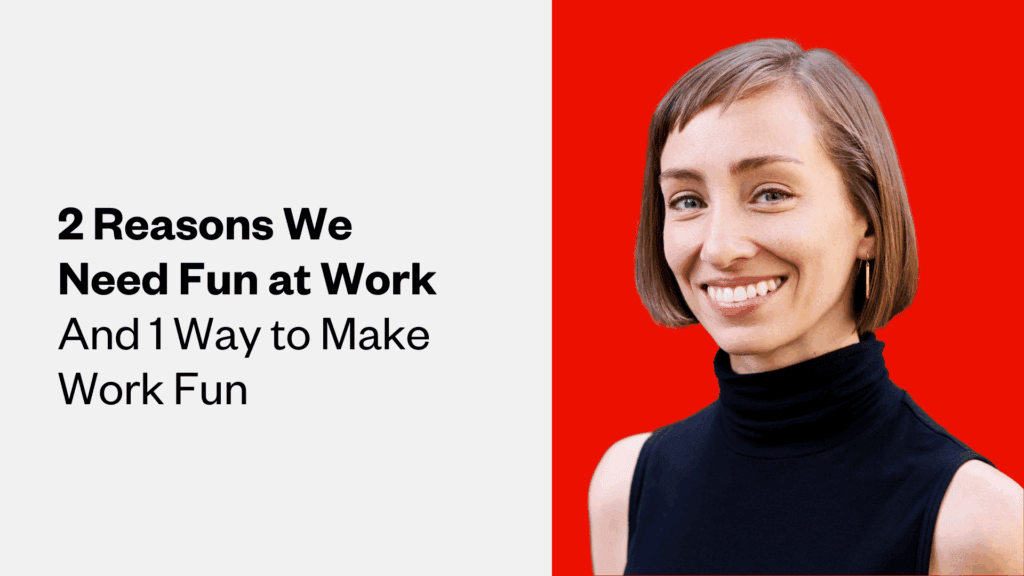
We’ve all been there: staring at the office clock, counting down the minutes, waiting for the weekend. But if we only have so much time on this planet, why are we spending our days wishing they were over? Bree Groff argues that it’s not only possible but necessary to have fun at work—not only as a perk, but a fundamental driver of success and a profound human necessity. Bree is a workplace consultant who’s worked with companies like Microsoft and Pfizer, as well as the author of Today Was Fun: A Book About Work (Seriously). She sat down with us on our podcast, Lavin Voices, to argue for a “third way” of work: one that reframes work not as painful or as our ultimate calling, but simply a nice way to spend our days. Bree gave us 2 reasons work should be fun, and 1 way to make it fun. Find her insights below, and get in touch to book her to speak at your event!
Reason 1: Fun drives productivity and profit.
Are you a leader focused on the bottom line? You need fun at work.
This means that it’s not simply nice to have fun at work. It’s actually better for our bottom line. The pervasive idea that “work is called work for a reason,” implying it must be hard or unpleasant, is a myth. We’re not paid because work is inherently painful, Bree says—we’re paid because we create value that others want. And there’s an intrinsic joy to work: using our skills, building things with others, and leaving the world better than we found it. When we foster this vitality, we’re not just creating happier employees; we’re unlocking significant gains in efficiency, innovation, and profitability.
Reason 2: Fun lets us be our better selves.
Beyond the numbers, there’s a profound human reason to prioritize fun: our authenticity. Bree argues that performative professionalism gets in the way of psychological safety. The expectation to don a “business mask”—to be palatable, presentable, and to conform to rigid, formal norms—stifles our human expression and creativity. When we feel the need to perform in order to be taken seriously, she says, we’re not thinking about “Am I having a good day? Is this day worthy of my life?” Instead, we’re consumed by the need to show up well.
This isn’t just personally taxing. It’s bad for business—because people aren’t sharing their “best, bravest ideas.” It’s hard to truly contribute if we don’t first feel like ourselves.
Ultimately, the most compelling case for integrating fun into work is existential: “We all are going to run out of Mondays,” Bree says. “They are not a renewable resource.” As leaders, when we consider our team members, the goal isn’t just to extract maximum business value. It’s to be a good steward of your own days and your team members’ days, ensuring that they’re not just fun, but a good way to spend your time on the planet.
1 way to make work fun: The “Do-Nothing Day”
So, how do we operationalize this? While sweeping structural changes like a four-day work week are certainly on the table, managers and team leaders can start much smaller. One powerful tactic Bree champions is the “Do-Nothing Day.”
“We are not wired to do our most expansive creative thinking in 30 minute blocks,” Bree says. Great ideas often emerge when we’re doing nothing—gardening, or taking a shower—because these are the few times our brains are truly free. So why not do nothing… together?
To foster this creativity, Bree takes executive teams away from the office for an unstructured offsite. “You can think of it as a Do-Nothing Day but a Think-Everything Day,” she explains. It’s a dedicated space, away from the pressure cooker of back-to-back meetings, to think, brainstorm, and just chat about the business. To generate brilliant ideas—ideas that people pay us for—we need some amount of slack in the system. “If our competitive advantage is going to be to play, to dream, to think compassionately about our customers or clients, we need some time to mess up. We need some time to play. We need some time to kick around ideas,” Bree says. The Do-Nothing Day allows for expansive, creative thought, ensuring that our uniquely human capabilities are fully leveraged, especially as AI handles more of the operational, 24/7 tasks.
The human imperative of fun
Bree’s call to inject fun into work is a business strategy and a human right. From driving productivity to fostering authenticity, fun is a cornerstone of a thriving, innovative workplace. By embracing concepts like the “Do-Nothing Day” and challenging ingrained notions of professionalism and pain, leaders can empower their teams—and themselves—to find vitality and purpose in their daily work.
The call to have fun at work is not a castle in the sky, but an achievable reality we have the agency to create, starting today.
Want more from Bree?
Watch her Lavin Voices episode below, and contact us to book her to speak at your event!
Reason 1: Fun drives productivity and profit.
Are you a leader focused on the bottom line? You need fun at work.
Bree points to findings that companies with highly engaged employees are 17% more productive and 23% more profitable. In fact, having a best friend at work is highly correlated with business outcomes, spanning everything from retention and productivity to inventory control and safety.
This means that it's not simply nice to have fun at work. It's actually better for our bottom line. The pervasive idea that "work is called work for a reason," implying it must be hard or unpleasant, is a myth. We're not paid because work is inherently painful, Bree says—we're paid because we create value that others want. And there's an intrinsic joy to work: using our skills, building things with others, and leaving the world better than we found it. When we foster this vitality, we're not just creating happier employees; we're unlocking significant gains in efficiency, innovation, and profitability.
Reason 2: Fun lets us be our better selves.
Beyond the numbers, there's a profound human reason to prioritize fun: our authenticity. Bree argues that performative professionalism gets in the way of psychological safety. The expectation to don a "business mask"—to be palatable, presentable, and to conform to rigid, formal norms—stifles our human expression and creativity. When we feel the need to perform in order to be taken seriously, she says, we're not thinking about "Am I having a good day? Is this day worthy of my life?" Instead, we're consumed by the need to show up well.
This isn't just personally taxing. It's bad for business—because people aren't sharing their "best, bravest ideas." It's hard to truly contribute if we don't first feel like ourselves.
Ultimately, the most compelling case for integrating fun into work is existential: "We all are going to run out of Mondays," Bree says. "They are not a renewable resource." As leaders, when we consider our team members, the goal isn't just to extract maximum business value. It's to be a good steward of your own days and your team members' days, ensuring that they're not just fun, but a good way to spend your time on the planet.
1 way to make work fun: The "Do-Nothing Day"
So, how do we operationalize this? While sweeping structural changes like a four-day work week are certainly on the table, managers and team leaders can start much smaller. One powerful tactic Bree champions is the "Do-Nothing Day."
"We are not wired to do our most expansive creative thinking in 30 minute blocks," Bree says. Great ideas often emerge when we're doing nothing—gardening, or taking a shower—because these are the few times our brains are truly free. So why not do nothing... together?
To foster this creativity, Bree takes executive teams away from the office for an unstructured offsite. "You can think of it as a Do-Nothing Day but a Think-Everything Day," she explains. It's a dedicated space, away from the pressure cooker of back-to-back meetings, to think, brainstorm, and just chat about the business. To generate brilliant ideas—ideas that people pay us for—we need some amount of slack in the system. "If our competitive advantage is going to be to play, to dream, to think compassionately about our customers or clients, we need some time to mess up. We need some time to play. We need some time to kick around ideas," Bree says. The Do-Nothing Day allows for expansive, creative thought, ensuring that our uniquely human capabilities are fully leveraged, especially as AI handles more of the operational, 24/7 tasks.
The human imperative of fun
Bree's call to inject fun into work is a business strategy and a human right. From driving productivity to fostering authenticity, fun is a cornerstone of a thriving, innovative workplace. By embracing concepts like the "Do-Nothing Day" and challenging ingrained notions of professionalism and pain, leaders can empower their teams—and themselves—to find vitality and purpose in their daily work.
The call to have fun at work is not a castle in the sky, but an achievable reality we have the agency to create, starting today.
Want more from Bree?
Watch her Lavin Voices episode below, and contact us to book her to speak at your event!
https://www.youtube.com/watch?v=TPfXtVDkdp8