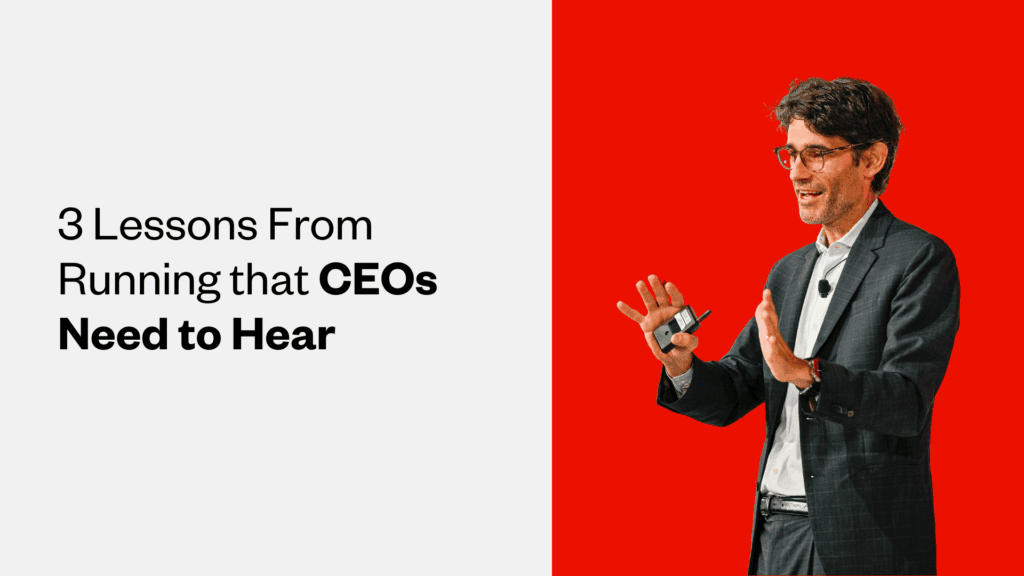
3 Lessons From Running That CEOs Need to Hear: Atlantic CEO Nicholas Thompson

“When you run, it’s just you,” says Nick Thompson. “If you succeed, it’s your success. If you fail, it’s your failure.” The CEO of The Atlantic and former editor-in-chief of WIRED, Nick is an ultrarunning record-holder—and he attributes much of his success to the habits and discipline that running has taught him. In a world demanding unparalleled accountability, the lessons he’s learned from his running career offer profound insights for CEOs navigating complex business landscapes. Nick sat down with us for our podcast, Lavin Voices, to discuss his new book, The Running Ground, and offer 3 lessons from running that CEOs need to learn. Below, find his insights on strategic discomfort, the enduring power of wisdom, and the surprising advantage of personal hobbies—and get in touch to book him to speak at your event!

1. You can go further than you think.

Our greatest limitations often reside not in our capabilities, but in our minds. “The reason you slow in running is that your body wants you to maintain homeostasis,” Nick says. “Your brain triggers a pain response, and then that is what makes you slow.” Our subconscious brain, wired for comfort and predictability, can prematurely signal “pain” when conditions get difficult, making us halt before true physiological limits are met.

And this isn’t just about running. It offers a blueprint for executive decision-making. Leaders must embrace strategic discomfort, Nick says: “You should sometimes try to go too fast and do things that seem impossible.” This isn’t recklessness—it’s a calculated push against mental barriers. “The way you get better is by going at an uncomfortable speed.” For a CEO, this might mean increasing sales targets, compressing project timelines, or exploring radically new market strategies. It’s in these moments of perceived impossibility that true breakthroughs are engineered.

2. Think you’ve hit your peak? Think again.

The traditional view of peak performance often suggests a linear ascent followed by an inevitable decline. But Nick’s own running narrative defies this, revealing a path of “rolling peaks.”

“My slowest times are at my athletic peak,” he says. “At age 30, I get good, and I stay basically constant until I’m 43 and then I get massively better.” This non-linear trajectory is a powerful metaphor for executive careers. Success isn’t about reaching a singular summit and then gracefully descending; it’s about continuous engagement, learning, and adaptation.

“Age is a moving sidewalk going backwards, but wisdom is a moving sidewalk going forwards,” Nick says. For leaders, this means actively seeking out and applying new insights to outpace the challenges that come with an evolving market and a longer career. The secret to sustained excellence, he argues, is consistent commitment: “You don’t stop running because you get old. You get old because you stop running. If you stay focused, you can learn enough to compensate.” CEOs must remain perpetual students of their industry, consistently acquiring “wisdom” to compensate for shifting landscapes and lead with enduring relevance.

3. Get a hobby. It’ll make you better.

In the demanding world of the C-suite, personal pursuits are often viewed as necessary breaks or even distractions. But Nick, a CEO, ultrarunner, and former editor-in-chief, offers a radical reframe: ambitious hobbies can be “additive” to professional success, not merely a counterbalance. Running, for him, “gives me a chance to relax. I fit it in in very efficient ways, and I often think through big problems when I run.” His personal passion is a catalyst for strategic thought and a personal laboratory for resilience.

This integrated approach extends to how leaders foster talent. Nick contrasts a coach who demanded “all in” dedication to running, which led to burnout and failure, with a later coach who helped him fit his hobby into a more ambitious, complicated life. This latter approach “unlocked this talent” because it acknowledged and integrated his multifaceted ambitions.

For CEOs, this means fostering a holistic leadership approach, both for themselves and their teams. By embracing challenging personal passions, executives can cultivate mental clarity, enhance problem-solving, and develop a deeper understanding of dedication and discipline. It’s about designing a life where professional ambition and personal fulfillment are not in conflict, but are interwoven, each fueling the other for greater overall impact.

Nick’s journey from weekend jogger to ultrarunning record-holder, all while leading major media companies, offers a clear blueprint for modern CEOs. Embrace strategic discomfort to push past mental barriers, leverage continuous learning and wisdom to sustain growth through “rolling peaks,” and integrate ambitious personal hobbies as powerful “additive advantages” for a more effective, innovative, and fulfilling leadership journey. The path to breakthrough leadership, much like the 50 km run, is a test of will, adaptability, and the profound connection between mind, body, and enduring purpose.

Want more from Nick?

Watch his Lavin Voices episode below, and get in touch to book him to speak at your event!

1. You can go further than you think.

Our greatest limitations often reside not in our capabilities, but in our minds. "The reason you slow in running is that your body wants you to maintain homeostasis," Nick says. "Your brain triggers a pain response, and then that is what makes you slow." Our subconscious brain, wired for comfort and predictability, can prematurely signal "pain" when conditions get difficult, making us halt before true physiological limits are met. And this isn't just about running. It offers a blueprint for executive decision-making. Leaders must embrace strategic discomfort, Nick says: "You should sometimes try to go too fast and do things that seem impossible." This isn't recklessness—it's a calculated push against mental barriers. "The way you get better is by going at an uncomfortable speed." For a CEO, this might mean increasing sales targets, compressing project timelines, or exploring radically new market strategies. It’s in these moments of perceived impossibility that true breakthroughs are engineered.

2. Think you've hit your peak? Think again.

The traditional view of peak performance often suggests a linear ascent followed by an inevitable decline. But Nick's own running narrative defies this, revealing a path of "rolling peaks." "My slowest times are at my athletic peak," he says. "At age 30, I get good, and I stay basically constant until I'm 43 and then I get massively better." This non-linear trajectory is a powerful metaphor for executive careers. Success isn't about reaching a singular summit and then gracefully descending; it's about continuous engagement, learning, and adaptation. "Age is a moving sidewalk going backwards, but wisdom is a moving sidewalk going forwards," Nick says. For leaders, this means actively seeking out and applying new insights to outpace the challenges that come with an evolving market and a longer career. The secret to sustained excellence, he argues, is consistent commitment: "You don't stop running because you get old. You get old because you stop running. If you stay focused, you can learn enough to compensate." CEOs must remain perpetual students of their industry, consistently acquiring "wisdom" to compensate for shifting landscapes and lead with enduring relevance.

3. Get a hobby. It'll make you better.

In the demanding world of the C-suite, personal pursuits are often viewed as necessary breaks or even distractions. But Nick, a CEO, ultrarunner, and former editor-in-chief, offers a radical reframe: ambitious hobbies can be "additive" to professional success, not merely a counterbalance. Running, for him, "gives me a chance to relax. I fit it in in very efficient ways, and I often think through big problems when I run." His personal passion is a catalyst for strategic thought and a personal laboratory for resilience. This integrated approach extends to how leaders foster talent. Nick contrasts a coach who demanded "all in" dedication to running, which led to burnout and failure, with a later coach who helped him fit his hobby into a more ambitious, complicated life. This latter approach "unlocked this talent" because it acknowledged and integrated his multifaceted ambitions. For CEOs, this means fostering a holistic leadership approach, both for themselves and their teams. By embracing challenging personal passions, executives can cultivate mental clarity, enhance problem-solving, and develop a deeper understanding of dedication and discipline. It's about designing a life where professional ambition and personal fulfillment are not in conflict, but are interwoven, each fueling the other for greater overall impact. Nick’s journey from weekend jogger to ultrarunning record-holder, all while leading major media companies, offers a clear blueprint for modern CEOs. Embrace strategic discomfort to push past mental barriers, leverage continuous learning and wisdom to sustain growth through "rolling peaks," and integrate ambitious personal hobbies as powerful "additive advantages" for a more effective, innovative, and fulfilling leadership journey. The path to breakthrough leadership, much like the 50 km run, is a test of will, adaptability, and the profound connection between mind, body, and enduring purpose.

Want more from Nick?

Watch his Lavin Voices episode below, and get in touch to book him to speak at your event! https://youtu.be/DdcZMnD2dxU?si=ZUbnE0FNOj6fKKew

Most Popular

FOLLOW US

Other News