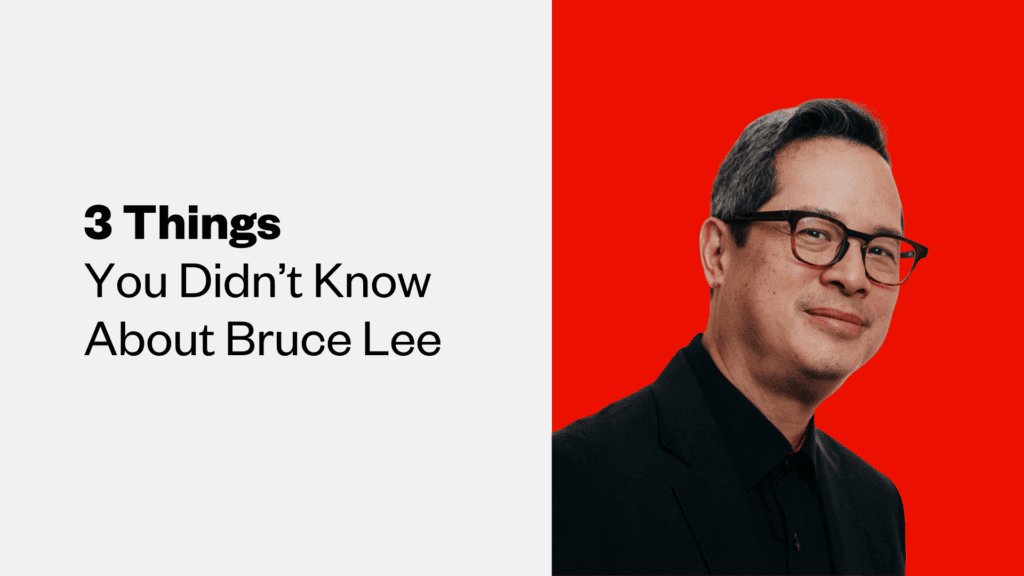
3 Things You Didn’t Know About Bruce Lee (and Why They Matter)

Everyone knows Bruce Lee could fight. The yellow tracksuit, the nunchucks, the one-inch punch—it’s all burned into popular culture. But did you know that the man who became the world’s most famous Asian American also danced the cha-cha, nearly starved to death under Japanese occupation, and taught himself success principles from self-help books?

Cultural historian Jeff Chang has spent years uncovering the story behind this martial arts icon. In his highly acclaimed new biography, Water Mirror Echo: Bruce Lee and the Making of Asian America, Jeff reveals a much more complex figure than the martial arts legend we think we know. Publishers Weekly writes that “this definitive account cements Chang as a preeminent chronicler of Asian American history.” Below, discover three surprising facts about Bruce Lee that reframe his entire legacy. And then contact us to book Jeff to speak at your next event about identity, culture, resilience, and solidarity.

1. He was a bookworm who mixed Taoism with American self-help

Bruce Lee moved to Seattle in his 20s—“and everyone in their 20s is searching for something,” says Jeff Chang. Seattle, with its segregated communities of poor white people, Black people, Latinx people, and especially Japanese-Americans, taught him that being American meant being for the underdog. But it also gave him access to American self-help literature: Napoleon Hill’s Think and Grow Rich, the doctrine of positive thinking, the whole idea that you can make yourself whoever you want to be.

“He finds, in these books, an encouragement: to pull himself up by his own bootstraps and make something of himself. And so he creates this really interesting self philosophy that mixes up Zen, Buddhism, Taoism and American self-help doctrines,” Jeff explains in this week’s episode of our podcast, Lavin Voices. It’s a uniquely American move: taking Eastern philosophy and Western can-do optimism and creating something entirely new.

That famous Bruce Lee quote about being like water? That’s ancient Taoism. But the drive to “be self-reliant,” to believe you can will yourself into greatness? That’s pure Emerson. Bruce synthesized both into a personal philosophy of self-actualization that still resonates today. Athletes like LeBron James and Klay Thompson quote him. Protesters in Hong Kong and Barcelona paint him on walls. His philosophy transcends borders—because it was always borderless.

2. War shaped his entire life

Bruce Lee nearly died as a child during WWII. “Bruce was deeply shaped by war,” Jeff says. “He nearly starved to death as a child in war-torn, Japanese-occupied Hong Kong.”

And the fighting didn’t end when Japan surrendered. When Mao won the Chinese Civil War in 1949, refugees poured into Hong Kong from all over China—and they brought their regional fighting styles with them. Suddenly you had this massive youth population, packed into a small space, with different kung fu traditions colliding. A street fighting culture exploded.

That’s where Bruce learned to actually fight. Not in some ancient monastery, but in the chaotic, improvised fight culture of post-war Hong Kong. “There’s a fight culture that develops,” Jeff explains, “and that’s the fight culture in which Bruce becomes a martial artist for the first time.”

Later, when Bruce came to America and enrolled in college, he was automatically put into the Reserve Officers’ Training Corps—preparing to potentially fight in Korea or Vietnam, against people who looked more like him than the white Americans who surrounded him. That experience of being seen as foreign, as other, is inseparable from why he fought so hard for representation and why his image still resonates with anyone who’s ever felt like an outsider.

3. He died too young—but in doing so, became a symbol of solidarity

Here’s what most people miss about Bruce Lee: the journey isn’t just from weakness to strength. It’s from self-defense to representation to solidarity.

Jeff traces a clear evolution in Asian American history, one that Bruce’s life and legacy embodies perfectly. “When violence happens to us, it turns us into Asian Americans—because the notion of Asian America affords us a sense of solidarity,” Jeff says. “Self defense leads us to demanding a seat at the table, right? But the seat at the table is not sufficient for us to all be able to feel like we’re going to be safe on the streets, so that’s what solidarity is all about.”

Bruce Lee’s image has become “infinitely flexible,” Jeff says—you can project almost anything onto that iconic stance. He’s been a hip-hop DJ in memes, a symbol of ethnic unity in the Balkans, a revolutionary icon in Catalonia’s independence movement. During the pandemic, when violence against Asian Americans surged, his image reappeared on murals across Chinatowns in America. Not as a call to violence, but as a reminder: we defend ourselves, we demand to be seen, and then we build solidarity with others fighting the same fight.

“It’s ultimately about us being able to be seen and recognized, so that people come to our aid and we come to other people’s aid,” Jeff explains. “That’s the heroic part of it—this leap from representation into solidarity.”

That’s why Bruce Lee still matters in 2025. Not because he could do a one-inch punch, but because his image gives people permission to imagine that things could be better than they are. “In that sense, he’s a vessel,” Jeff says. “And we’re the water.”

Interested in hearing more from Jeff?

Learn more about him here, and get in touch with us to book him to speak at your event. You can also explore our curated list of the top speakers on inclusion, and watch Jeff’s episode of our podcast, Lavin Voices, here:

1. He was a bookworm who mixed Taoism with American self-help

Bruce Lee moved to Seattle in his 20s—“and everyone in their 20s is searching for something,” says Jeff Chang. Seattle, with its segregated communities of poor white people, Black people, Latinx people, and especially Japanese-Americans, taught him that being American meant being for the underdog. But it also gave him access to American self-help literature: Napoleon Hill's Think and Grow Rich, the doctrine of positive thinking, the whole idea that you can make yourself whoever you want to be. "He finds, in these books, an encouragement: to pull himself up by his own bootstraps and make something of himself. And so he creates this really interesting self philosophy that mixes up Zen, Buddhism, Taoism and American self-help doctrines," Jeff explains in this week’s episode of our podcast, Lavin Voices. It's a uniquely American move: taking Eastern philosophy and Western can-do optimism and creating something entirely new. That famous Bruce Lee quote about being like water? That's ancient Taoism. But the drive to "be self-reliant," to believe you can will yourself into greatness? That's pure Emerson. Bruce synthesized both into a personal philosophy of self-actualization that still resonates today. Athletes like LeBron James and Klay Thompson quote him. Protesters in Hong Kong and Barcelona paint him on walls. His philosophy transcends borders—because it was always borderless.

2. War shaped his entire life

Bruce Lee nearly died as a child during WWII. "Bruce was deeply shaped by war,” Jeff says. “He nearly starved to death as a child in war-torn, Japanese-occupied Hong Kong.” And the fighting didn't end when Japan surrendered. When Mao won the Chinese Civil War in 1949, refugees poured into Hong Kong from all over China—and they brought their regional fighting styles with them. Suddenly you had this massive youth population, packed into a small space, with different kung fu traditions colliding. A street fighting culture exploded. That's where Bruce learned to actually fight. Not in some ancient monastery, but in the chaotic, improvised fight culture of post-war Hong Kong. "There's a fight culture that develops," Jeff explains, "and that's the fight culture in which Bruce becomes a martial artist for the first time." Later, when Bruce came to America and enrolled in college, he was automatically put into the Reserve Officers' Training Corps—preparing to potentially fight in Korea or Vietnam, against people who looked more like him than the white Americans who surrounded him. That experience of being seen as foreign, as other, is inseparable from why he fought so hard for representation and why his image still resonates with anyone who's ever felt like an outsider.

3. He died too young—but in doing so, became a symbol of solidarity

Here's what most people miss about Bruce Lee: the journey isn't just from weakness to strength. It's from self-defense to representation to solidarity. Jeff traces a clear evolution in Asian American history, one that Bruce's life and legacy embodies perfectly. "When violence happens to us, it turns us into Asian Americans—because the notion of Asian America affords us a sense of solidarity,” Jeff says. “Self defense leads us to demanding a seat at the table, right? But the seat at the table is not sufficient for us to all be able to feel like we're going to be safe on the streets, so that's what solidarity is all about." Bruce Lee's image has become "infinitely flexible," Jeff says—you can project almost anything onto that iconic stance. He's been a hip-hop DJ in memes, a symbol of ethnic unity in the Balkans, a revolutionary icon in Catalonia's independence movement. During the pandemic, when violence against Asian Americans surged, his image reappeared on murals across Chinatowns in America. Not as a call to violence, but as a reminder: we defend ourselves, we demand to be seen, and then we build solidarity with others fighting the same fight. "It's ultimately about us being able to be seen and recognized, so that people come to our aid and we come to other people's aid," Jeff explains. "That's the heroic part of it—this leap from representation into solidarity." That's why Bruce Lee still matters in 2025. Not because he could do a one-inch punch, but because his image gives people permission to imagine that things could be better than they are. “In that sense, he’s a vessel,” Jeff says. “And we're the water.”

Interested in hearing more from Jeff?

Learn more about him here, and get in touch with us to book him to speak at your event. You can also explore our curated list of the top speakers on inclusion, and watch Jeff's episode of our podcast, Lavin Voices, here: https://youtu.be/9hFMl6WhdqM?si=Pc4B5hN5VhSSv2bp

Most Popular

FOLLOW US

Other News