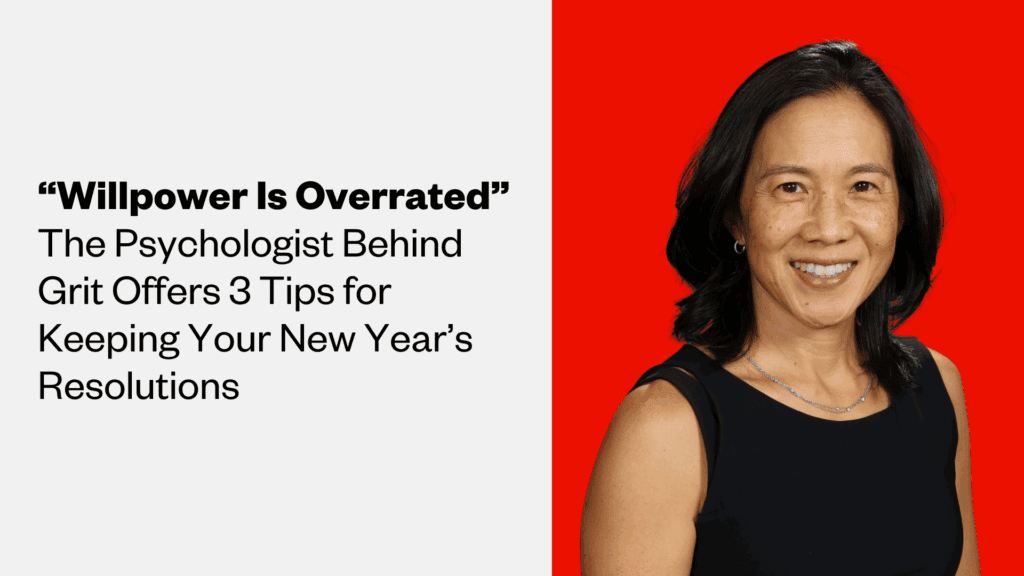
3 Ways to Actually Keep Your New Year’s Resolutions, From the Scientist Behind Grit (Hint: It’s Not Willpower)

If you’re like us, you’ve set a goal with fierce determination… only to feel that initial fire start to flicker by February. You want to read more, exercise consistently, or spend less time scrolling, but the daily grind wears you down. The usual advice we get is to “Just try harder.” But what if willpower is actually overrated? That’s the provocative argument from celebrated psychologist Angela Duckworth, the #1 New York Times bestselling author of Grit and the forthcoming book Situated: Finding the People and Places That Bring Out Your Best. In a recent popular opinion article for The New York Times, she reveals that people who successfully achieve their goals don’t have more inner fortitude than the rest of us. Instead, they use a smarter strategy: they change their environment so that willpower is barely needed. This New Year’s, find Angela’s 3 tips for keeping your 2026 resolutions below.

1. Become the Architect of Your Environment

The most effective way to resist temptation is to make sure you rarely encounter it. “You are the sovereign of what enters your personal space,” Angela writes in her op-ed for The New York Times. “Physical distance creates psychological distance: Draw close what you want more of; push away what you want less.” Instead of fighting a losing battle with the cookies in your pantry every evening, you can make sure the cookies never enter the pantry to begin with.

How to do it:

  • Goal: Eat Healthier? Don’t buy the junk food. If it’s not in your house, you can’t eat it when you’re tired and your defenses are down.
  • Goal: Less Screen Time? Don’t bring your phone to the dinner table or into your bedroom. A recent study from Angela and her colleagues found that students who simply put their phones in another room while studying earned higher grades.
  • Goal: Save More Money? Unsubscribe from marketing emails and unfollow brands on social media that tempt you to spend.

2. Make Good Habits Easy to Start

Two-time Olympic gold medalist Alistair Brownlee doesn’t rely on motivation to get him out the door for a workout. He makes it as easy as possible: laying out his gear the night before, making sure his shoes are warm and dry by the door, even buying a house that was close to trails and pools. “My mantra in life has always been to take the first step,” he says.

The hardest part of any new habit is the friction of starting. Your job is to reduce that friction until the good choice is the path of least resistance.

How to do it:

  • Goal: Morning Workouts? Lay out your gym clothes, shoes, headphones, and water bottle before you go to bed. When your alarm goes off, there’s no thinking involved—just doing.
  • Goal: Read More? Instead of leaving your phone on your nightstand, leave a book there.
  • Goal: Drink More Water? Carry a full water bottle with you everywhere. Make it your new sidekick, just like Jennifer Lopez does.

3. Make Bad Habits Inconvenient (or Impossible)

Just as you can make good habits easier, you can actively make bad habits harder. The writer David Sedaris found it easier to quit smoking weed when he moved from New York, where it was easily delivered to his door, to Paris, where he had no idea how to get it.

When you increase the effort required for a bad habit, you give your better self a fighting chance to make a different choice.

How to do it:

  • Goal: Stop Hitting Snooze? Put your alarm clock on the other side of the room. You’ll have to physically get out of bed to turn it off, making it much easier to just stay up.
  • Goal: Less Social Media? Log out of your social media accounts after each use. The extra step of having to log back in is often enough of a deterrent to prevent mindless scrolling. For a more extreme approach like author Zadie Smith, consider deleting the apps from your phone entirely.
  • Goal: Watch Less TV? Take the batteries out of the remote and put them in a drawer in another room. That small bit of friction can be the difference between slumping on the couch and doing something more productive.

By designing a situation that supports your goals this year, you make success the default, not a daily struggle.

Want more from Angela?

Get in touch to book her to speak at your event!

1. Become the Architect of Your Environment

The most effective way to resist temptation is to make sure you rarely encounter it. "You are the sovereign of what enters your personal space," Angela writes in her op-ed for The New York Times. "Physical distance creates psychological distance: Draw close what you want more of; push away what you want less." Instead of fighting a losing battle with the cookies in your pantry every evening, you can make sure the cookies never enter the pantry to begin with. How to do it:
  • Goal: Eat Healthier? Don't buy the junk food. If it's not in your house, you can't eat it when you're tired and your defenses are down.
  • Goal: Less Screen Time? Don't bring your phone to the dinner table or into your bedroom. A recent study from Angela and her colleagues found that students who simply put their phones in another room while studying earned higher grades.
  • Goal: Save More Money? Unsubscribe from marketing emails and unfollow brands on social media that tempt you to spend.

2. Make Good Habits Easy to Start

Two-time Olympic gold medalist Alistair Brownlee doesn’t rely on motivation to get him out the door for a workout. He makes it as easy as possible: laying out his gear the night before, making sure his shoes are warm and dry by the door, even buying a house that was close to trails and pools. “My mantra in life has always been to take the first step,” he says. The hardest part of any new habit is the friction of starting. Your job is to reduce that friction until the good choice is the path of least resistance. How to do it:
  • Goal: Morning Workouts? Lay out your gym clothes, shoes, headphones, and water bottle before you go to bed. When your alarm goes off, there’s no thinking involved—just doing.
  • Goal: Read More? Instead of leaving your phone on your nightstand, leave a book there.
  • Goal: Drink More Water? Carry a full water bottle with you everywhere. Make it your new sidekick, just like Jennifer Lopez does.

3. Make Bad Habits Inconvenient (or Impossible)

Just as you can make good habits easier, you can actively make bad habits harder. The writer David Sedaris found it easier to quit smoking weed when he moved from New York, where it was easily delivered to his door, to Paris, where he had no idea how to get it. When you increase the effort required for a bad habit, you give your better self a fighting chance to make a different choice. How to do it:
  • Goal: Stop Hitting Snooze? Put your alarm clock on the other side of the room. You’ll have to physically get out of bed to turn it off, making it much easier to just stay up.
  • Goal: Less Social Media? Log out of your social media accounts after each use. The extra step of having to log back in is often enough of a deterrent to prevent mindless scrolling. For a more extreme approach like author Zadie Smith, consider deleting the apps from your phone entirely.
  • Goal: Watch Less TV? Take the batteries out of the remote and put them in a drawer in another room. That small bit of friction can be the difference between slumping on the couch and doing something more productive.
By designing a situation that supports your goals this year, you make success the default, not a daily struggle.

Want more from Angela?

Get in touch to book her to speak at your event! https://youtu.be/Q_-eoom1dtw

Most Popular

FOLLOW US

Other News