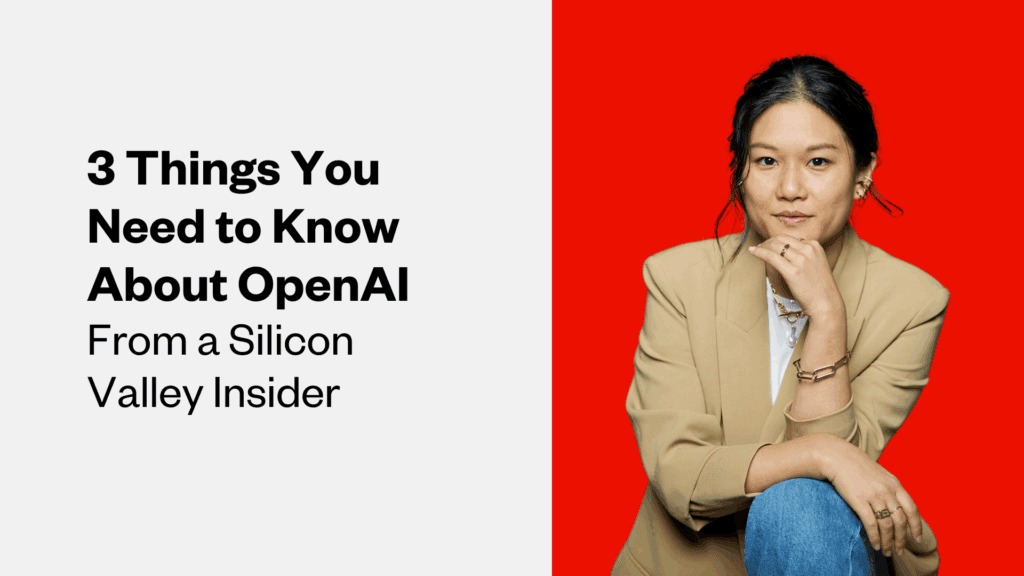
3 Things You Need to Know About OpenAI: Inside the Greatest Tech Arms Race in History
When OpenAI launched a decade ago, it promised to save humanity from profit-driven AI development. The nonprofit would open-source everything, develop AI in the public interest, and stand as the anti-Google. Today, that same organization is valued at $500 billion and guards its technology like state secrets. What happened?
TIME100 AI honoree Karen Hao, the first journalist to ever profile OpenAI and author of the instant New York Times bestseller Empire of AI, has spent years investigating the industry defining our era. In keynote talks, she draws on her deep insider access to offer trenchant and vital insights on AI and democracy. A top AI speaker, she sat down with Lavin to reveal 3 things that everyone should know about OpenAI—find them below, and then contact us to book Karen to speak at your next event!
1. OpenAI was built to benefit humanity. Or was it?
In 2019, Karen became the first journalist to profile OpenAI. She went in believing in their mission of transparency and building AI for the good of humanity. By the end of her interviews, she wasn’t so sure. “I realized that this was not actually a nonprofit. They didn’t operate like a nonprofit. They didn’t operate with the kind of values that they publicly espoused about how they were going to open source everything and do everything in the public interest,” Karen tells Lavin.
Elon Musk and Sam Altman founded OpenAI with the stated mission of developing AI for the public interest. But Karen discovered a different reality during her embedded reporting. The company that promised to open-source everything was hyper-secretive, hyper-competitive, and already orienting themselves towards commercialization. There was “a complete disconnect between what they said in order to raise money and what they did behind closed doors,” Karen explains.
This matters because it reveals a pattern: AI companies use the language of public benefit to accumulate resources, then pivot once they’ve consolidated power. When you hear AI leaders talk about “benefiting humanity,” look at what they do, not what they say.
2. ChatGPT is designed to keep you hooked.
Here’s something that might surprise you: ChatGPT wasn’t actually a technological breakthrough. “The technology that ChatGPT is based on had actually already existed for several years prior to ChatGPT,” Karen says. Even journalists covering AI “kind of missed the ChatGPT story initially because it was so outdated as a technology in our eyes.”
So what made it revolutionary? “It was more of an innovation in packaging,” she explains.
“Having a really easy and free interface on an older technology fundamentally changed its permeation level in society, and it fundamentally changed how people perceive the technology,” Karen notes. But more importantly, “the way that OpenAI designed this interface to be like a chatty human friend taps into human psychology and makes it a particularly addictive and easy to use product.”
3. AI is an empire, and democracy is the price…
“Sam Altman once sat on stage,” Karen recounts, “and said that soon enough, there will be a single person company that hits like a $1 trillion market cap.” She found his reaction telling: “He thought it was hilarious and charming that a single person can accumulate that much with not that much effort.”
This isn’t about innovation anymore. It’s about empire.
“The amount of capital and resources and knowledge that is now being monopolized by AI companies is of an order of magnitude, two orders, three orders of magnitude more than what we saw with even Facebook, Microsoft and Google before,” Karen says. But here’s what Empire of AI reveals that others miss: this concentration of power isn’t a bug, it’s a feature. “AI is the ultimate tool for people with authoritarian tendencies who want to seek control.”
And the implications for democracy are stark: “I talk with a lot of people who don’t feel like they have any agency anymore. If you don’t believe that you have agency anymore, democracy stops existing,” she says. When we normalize feeling powerless against tech companies, “we return to the age of empire.”
… but it doesn’t have to be this way.
So much of the AI conversation has centered around generative AI. But the AI we actually need already exists. “A lot of the things that people would want from AI,—clean air, clean water, a more sustainable energy transition, better health care, better education—those technologies actually already exist,” Karen says. And instead of returning us to the age of empire, those AI tools have the capacity to bring us into a better future.
“We can channel the capital, the energy, the political will towards these other suite of technologies, and we’ll already start seeing immediate benefit,” Karen says. “And if we can use this moment as an opportunity to figure out how to regulate Silicon Valley, that will bring an extraordinary and needed rebalance to the world.” There’s a lot of work to be done—but the future is still ours for the taking.
Interested in understanding AI’s real impact on democracy and your organization?
1. OpenAI was built to benefit humanity. Or was it?
In 2019, Karen became the first journalist to profile OpenAI. She went in believing in their mission of transparency and building AI for the good of humanity. By the end of her interviews, she wasn't so sure. "I realized that this was not actually a nonprofit. They didn't operate like a nonprofit. They didn't operate with the kind of values that they publicly espoused about how they were going to open source everything and do everything in the public interest," Karen tells Lavin.
Elon Musk and Sam Altman founded OpenAI with the stated mission of developing AI for the public interest. But Karen discovered a different reality during her embedded reporting. The company that promised to open-source everything was hyper-secretive, hyper-competitive, and already orienting themselves towards commercialization. There was "a complete disconnect between what they said in order to raise money and what they did behind closed doors," Karen explains.
This matters because it reveals a pattern: AI companies use the language of public benefit to accumulate resources, then pivot once they've consolidated power. When you hear AI leaders talk about "benefiting humanity," look at what they do, not what they say.
2. ChatGPT is designed to keep you hooked.
Here's something that might surprise you: ChatGPT wasn't actually a technological breakthrough. "The technology that ChatGPT is based on had actually already existed for several years prior to ChatGPT," Karen says. Even journalists covering AI "kind of missed the ChatGPT story initially because it was so outdated as a technology in our eyes."
So what made it revolutionary? "It was more of an innovation in packaging," she explains.
"Having a really easy and free interface on an older technology fundamentally changed its permeation level in society, and it fundamentally changed how people perceive the technology," Karen notes. But more importantly, "the way that OpenAI designed this interface to be like a chatty human friend taps into human psychology and makes it a particularly addictive and easy to use product."
3. AI is an empire, and democracy is the price...
"Sam Altman once sat on stage," Karen recounts, "and said that soon enough, there will be a single person company that hits like a $1 trillion market cap." She found his reaction telling: "He thought it was hilarious and charming that a single person can accumulate that much with not that much effort."
This isn't about innovation anymore. It's about empire.
"The amount of capital and resources and knowledge that is now being monopolized by AI companies is of an order of magnitude, two orders, three orders of magnitude more than what we saw with even Facebook, Microsoft and Google before," Karen says. But here's what Empire of AI reveals that others miss: this concentration of power isn't a bug, it's a feature. "AI is the ultimate tool for people with authoritarian tendencies who want to seek control."
And the implications for democracy are stark: "I talk with a lot of people who don't feel like they have any agency anymore. If you don't believe that you have agency anymore, democracy stops existing," she says. When we normalize feeling powerless against tech companies, "we return to the age of empire."
... but it doesn't have to be this way.
So much of the AI conversation has centered around generative AI. But the AI we actually need already exists. "A lot of the things that people would want from AI,—clean air, clean water, a more sustainable energy transition, better health care, better education—those technologies actually already exist," Karen says. And instead of returning us to the age of empire, those AI tools have the capacity to bring us into a better future.
"We can channel the capital, the energy, the political will towards these other suite of technologies, and we'll already start seeing immediate benefit," Karen says. "And if we can use this moment as an opportunity to figure out how to regulate Silicon Valley, that will bring an extraordinary and needed rebalance to the world." There's a lot of work to be done—but the future is still ours for the taking.
Interested in understanding AI's real impact on democracy and your organization?