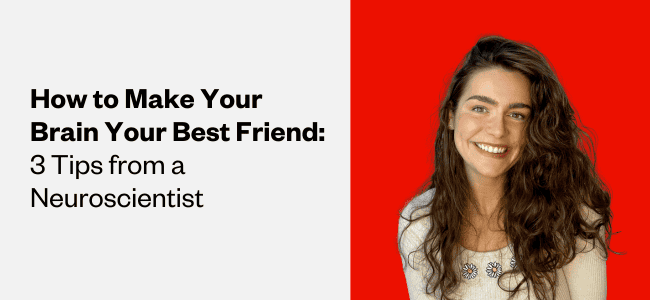
Rachel is a playful and bracingly real science communicator: an online phenom whose “Rachel the Neuroscientist” videos demystify the principles of brain science, empowering her over 2 million online followers. She sat down with Lavin to explain 3 ways to help your brain work for you instead of against you—and unlock resilience, joy, and connection in the process.
1. Stop trying to hack your brain.
If you were having a problem with your child, would you start trying to figure out how to hack your child? “You’d try to understand the distress and provide care,” Rachel says. “So why do we try to hack our brain into submission?”
Drawing on her new book, How to Make Your Brain Your Best Friend (out now!), Rachel suggests a new way of helping your brain work for you: by seeing it as an entity that’s separate from yourself. “Of course you are your brain, your brain is you. But when you think of yourself as two separate entities, suddenly it feels like you’re charged with the care of a wobbly little pet. And you realize that there are no hacks—only habits of kindness and care.”
2. Engineer moments of delight.
We spend our days laser-focused on things that stress us out. What if we built a habit of delight to help our brains navigate the modern world?
Rachel defines delight as “a pleasant experience, a moment of connectedness, that takes you by surprise.” This means it’s often spontaneous—but you can engineer opportunities for delight into your day.
Start by paying attention. Instead of focusing on your phone during your commute, look up and note what reliably brings you joy, awe, or connection. Then find the environments where delight is likely to occur. And don’t wait for the weekend or your yearly vacation—you can find time to recharge in the course of your everyday life, if you leave the door open for delight.
3. You have less control than you think.
We like to think that we’re sitting in the driver’s seat, with our brain in the backseat. We assume, for example, that we can scroll through videos of people being rude to one another without letting that affect our worldview. “But the brain is gobbling up everything indiscriminately, which meaningfully influences your feelings, your thoughts, your behaviors,” Rachel says.
The brain has its own agenda—it’s always trying to mend itself and protect you. “You don’t get to choose how it navigates the environments you put it in,” Rachel says. “What you do get to choose is what you’re feeding it.”
So the next time you’re tempted to wade through unhelpful or damaging information, remember the “wobbly little pet” you’re charged with—and choose to help it help you instead.
Interested in hearing more from Rachel?
Get in touch to learn more, and to book her to speak at your next event!
Rachel is a playful and bracingly real science communicator: an online phenom whose “Rachel the Neuroscientist” videos demystify the principles of brain science, empowering her over 2 million online followers. She sat down with Lavin to explain 3 ways to help your brain work for you instead of against you—and unlock resilience, joy, and connection in the process.
1. Stop trying to hack your brain.
If you were having a problem with your child, would you start trying to figure out how to hack your child? “You’d try to understand the distress and provide care,” Rachel says. “So why do we try to hack our brain into submission?”
Drawing on her new book,
How to Make Your Brain Your Best Friend (out now!), Rachel suggests a new way of helping your brain work for you: by seeing it as an entity that's separate from yourself. “Of course you are your brain, your brain is you. But when you think of yourself as two separate entities, suddenly it feels like you’re charged with the care of a wobbly little pet. And you realize that there are no hacks—only habits of kindness and care.”
2. Engineer moments of delight.
We spend our days laser-focused on things that stress us out. What if we built a habit of delight to help our brains navigate the modern world?
Rachel defines delight as “a pleasant experience, a moment of connectedness, that takes you by surprise.” This means it’s often spontaneous—but you can engineer opportunities for delight into your day.
Start by paying attention. Instead of focusing on your phone during your commute, look up and note what reliably brings you joy, awe, or connection. Then find the environments where delight is likely to occur. And don’t wait for the weekend or your yearly vacation—you can find time to recharge in the course of your everyday life, if you leave the door open for delight.
3. You have less control than you think.
We like to think that we’re sitting in the driver’s seat, with our brain in the backseat. We assume, for example, that we can scroll through videos of people being rude to one another without letting that affect our worldview. “But the brain is gobbling up everything indiscriminately, which meaningfully influences your feelings, your thoughts, your behaviors,” Rachel says.
The brain has its own agenda—it’s always trying to mend itself and protect you. “You don’t get to choose how it navigates the environments you put it in,” Rachel says. “What you do get to choose is what you’re feeding it.”
So the next time you’re tempted to wade through unhelpful or damaging information, remember the “wobbly little pet” you’re charged with—and choose to help it help you instead.
Interested in hearing more from Rachel?
Get in touch to learn more, and to book her to speak at your next event!