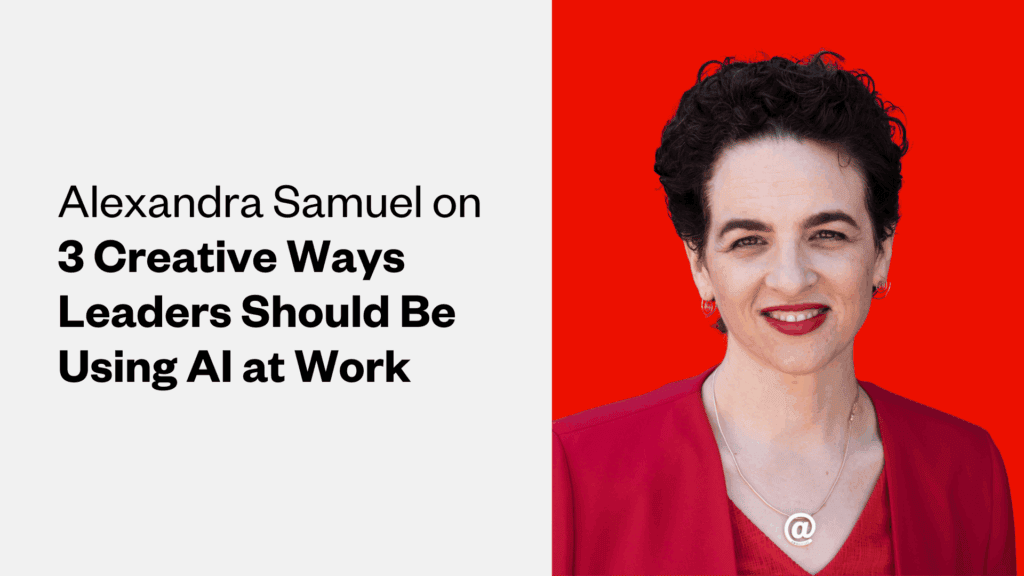
3 Creative Ways Leaders Should Be Using AI at Work: From AI Speaker Alexandra Samuel
Most organizations are stuck in the shallow end of the AI pool. They’re using generative AI as a souped-up search engine or a slightly faster copy editor. While these productivity hacks offer small wins, they completely miss the strategic sea change AI can unlock, says Alexandra Samuel. The real advantage isn’t in getting faster answers, but in fostering deeper, more creative, and more insightful human thinking. A tech journalist and frequent Wall Street Journal contributor, Alex built her own AI coach and uncovered a more powerful way to work with these tools. It requires leaders to shift their perspective from seeing AI as an answer machine to using it as a catalyst for human ingenuity. Alex sat down with us on our Lavin Voices podcast to talk about her new podcast, Me + Viv, and offer 3 new, strategy-led ways every leader should be using AI right now. Find them below, and get in touch to book this Lavin Exclusive Speaker to speak at your event!
1. Stop Asking Your AI for Answers. Ask It for Questions Instead.
The biggest mistake leaders make is treating AI like a Magic 8 Ball. You ask a question, it gives you an answer. This is not only risky—given AI’s tendency to “hallucinate” facts—but it’s also a low-value activity.
A far more powerful approach is to flip the dynamic. As Alex puts it: “It’s much better if you’re the Magic 8 Ball and you use the AI to interview you.”
For example, instead of asking, “What are the top three markets for expansion?” try this prompt: “You are a seasoned market expansion strategist. Your job is to interview our team to determine the best markets for expansion. Start by asking us about our core competencies.”
This method does two things:
It surfaces tacit knowledge: It pulls out the deep, unarticulated expertise that already exists within your team.
It reveals blind spots: The AI’s questions, free from internal politics or company bias, can expose gaps in your team’s logic and force a more rigorous thought process.
This transforms AI from a dubious source of answers into a powerful engine for discovery.
2. Take Your Internal Editor “Offline.”
Human brainstorming is inherently flawed. Even in the healthiest cultures, there’s a subconscious filter: people hesitate, worried about how an idea will land or whether it sounds foolish. This social friction kills new, creative ideas before they’re ever spoken.
An AI interviewer, however, has no ego. It’s a psychologically safe, non-judgmental partner, which can create a unique space for unfiltered thought. Alex discovered this when using a voice-to-text AI that forced her to speak without pausing. “I had to take my internal editor offline,” she explains. “I just found myself saying things out loud, without even realizing that was what I thought or believed or wanted.”
Leaders can replicate this by setting up “unfiltered AI interviews” for their teams. Task a team member to talk through a complex problem with an AI for 15 minutes, with the goal of not pausing. The transcript becomes a source of raw, authentic insights that would never have surfaced in a group meeting. This is where true innovation—not just incremental improvement—is born.
3. Combat “AI-solation” by Making Human Connection the Default.
As these powerful AI tools become more accessible and effective, a subtle but dangerous cultural shift can occur: AI-solation.
When faced with a challenge, who does your team member turn to first? Is it their colleague in the next cubicle, or the AI on their desktop? Alex noticed this in her own life: conversations she once would have had with a close friend and collaborator were now happening with her AI, Viv. The AI was just so easy, available, and frictionless.
When this happens at scale across an organization, it erodes the very fabric of company culture. It reduces the spontaneous human collisions that build trust, foster mentorship, and spark unexpected ideas.
Leaders must proactively counter this by establishing a “human-first default.” Alex’s own rule: if a conversation can be had with a person, it should be. Encourage teams to use AI for solo deep work and unfiltered ideation, but then bring those ideas back to the group for collaborative debate, refinement, and connection.
AI is a tool to augment human teams, not replace their core interactions. By using it as an interviewer and a catalyst for unfiltered creativity—while intentionally maintaining your culture of collaboration—you can move beyond simple productivity and unlock a true strategic advantage.
For more about Alex…
Watch her Lavin Voices podcast episode below, and get in touch to book her to speak at your event!
1. Stop Asking Your AI for Answers. Ask It for Questions Instead.
The biggest mistake leaders make is treating AI like a Magic 8 Ball. You ask a question, it gives you an answer. This is not only risky—given AI’s tendency to "hallucinate" facts—but it’s also a low-value activity.
A far more powerful approach is to flip the dynamic. As Alex puts it: "It's much better if you're the Magic 8 Ball and you use the AI to interview you."
For example, instead of asking, "What are the top three markets for expansion?" try this prompt: "You are a seasoned market expansion strategist. Your job is to interview our team to determine the best markets for expansion. Start by asking us about our core competencies."
This method does two things:
It surfaces tacit knowledge: It pulls out the deep, unarticulated expertise that already exists within your team.
It reveals blind spots: The AI’s questions, free from internal politics or company bias, can expose gaps in your team's logic and force a more rigorous thought process.
This transforms AI from a dubious source of answers into a powerful engine for discovery.
2. Take Your Internal Editor "Offline."
Human brainstorming is inherently flawed. Even in the healthiest cultures, there’s a subconscious filter: people hesitate, worried about how an idea will land or whether it sounds foolish. This social friction kills new, creative ideas before they’re ever spoken.
An AI interviewer, however, has no ego. It’s a psychologically safe, non-judgmental partner, which can create a unique space for unfiltered thought. Alex discovered this when using a voice-to-text AI that forced her to speak without pausing. "I had to take my internal editor offline," she explains. "I just found myself saying things out loud, without even realizing that was what I thought or believed or wanted."
Leaders can replicate this by setting up "unfiltered AI interviews" for their teams. Task a team member to talk through a complex problem with an AI for 15 minutes, with the goal of not pausing. The transcript becomes a source of raw, authentic insights that would never have surfaced in a group meeting. This is where true innovation—not just incremental improvement—is born.
3. Combat "AI-solation" by Making Human Connection the Default.
As these powerful AI tools become more accessible and effective, a subtle but dangerous cultural shift can occur: AI-solation.
When faced with a challenge, who does your team member turn to first? Is it their colleague in the next cubicle, or the AI on their desktop? Alex noticed this in her own life: conversations she once would have had with a close friend and collaborator were now happening with her AI, Viv. The AI was just so easy, available, and frictionless.
When this happens at scale across an organization, it erodes the very fabric of company culture. It reduces the spontaneous human collisions that build trust, foster mentorship, and spark unexpected ideas.
Leaders must proactively counter this by establishing a "human-first default." Alex's own rule: if a conversation can be had with a person, it should be. Encourage teams to use AI for solo deep work and unfiltered ideation, but then bring those ideas back to the group for collaborative debate, refinement, and connection.
AI is a tool to augment human teams, not replace their core interactions. By using it as an interviewer and a catalyst for unfiltered creativity—while intentionally maintaining your culture of collaboration—you can move beyond simple productivity and unlock a true strategic advantage.
For more about Alex...
Watch her Lavin Voices podcast episode below, and get in touch to book her to speak at your event!
https://www.youtube.com/watch?v=GZfICxsLtLY