Why do some people and teams thrive while others, with just as much talent, time, and money, stall out? One of the world’s top experts on human performance, David Epstein has spent his career investigating that question. The author of three New York Times bestsellers, including the #1 bestseller Range and his most recent Inside the Box (which Adam Grant calls “a masterful case that limits are what set us free”), David argues that the right constraints can help you focus a team, unstick a project, or even figure out where to start. He shows teams and individuals how to do more with less in an era when AI is making it easier than ever to produce more, faster, in every direction at once. Audiences learn to spot the bottlenecks actually limiting their performance and design constraints that channel effort where it matters most.
“David Epstein manages to make me thoroughly enjoy the experience of being told that everything I thought about something was wrong.”
—Malcolm Gladwell
A former investigative reporter for Sports Illustrated and ProPublica, David Epstein has spent his career examining—and overturning—our most deeply held assumptions about what makes people and teams perform at their best. Between them, his New York Times bestsellers Range: Why Generalists Triumph in a Specialized World and Inside the Box: How Constraints Make Us Better have topped recommended book lists from The Wall Street Journal, The Sunday Times, Financial Times, Forbes, Inc., Amazon, and Barnes & Noble. He has engaged in a notable “nerd fight of gladiatorial proportions” with Malcolm Gladwell, been featured on Good Morning America, CBS Mornings, CNBC’s Squawk Box, and Morning Joe, seen his books translated into more than 30 languages, and reached more than 12.5 million views with his two TED Talks.
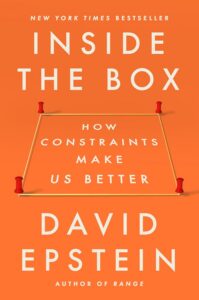
Building on questions that arose from his #1 New York Times bestseller Range — which Forbes called “the most important business (and parenting) book of the year” — his latest book, Inside the Box, continues his myth-busting pursuit of the secrets of high performance. It shows why the right constraints, not unlimited freedom and resources, are what help people and teams focus, create, and adapt. As Gladwell put it, “I’ll never think about my own work the same way again.” Adam Grant called it “masterful,” Angela Duckworth called it “wonderful,” and The Wall Street Journal wrote, “Boxing ourselves in may be the ultimate way to think outside the box.”
As a speaker and workshop leader, David has inspired global audiences from Amazon, Microsoft, Google, Target, Fidelity, J.P. Morgan, Deloitte, BCG, and Gartner to World 50, the Association for Talent Development, NASA, the U.S. Army, and the University of Pennsylvania. Combining surprising data and meticulous research with eye-catching graphics and thought-provoking stories from the worlds of sports, business, science, and the arts, he overturns conventional notions about both team performance and personal development.
Achieving Success in Any Domain
What if the conventional wisdom on the best path to success—specialize early, focus narrowly—is not just incomplete but actively misleading?
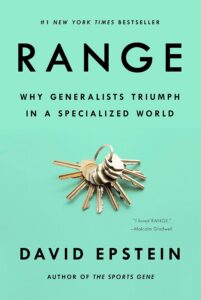
In this talk based on his #1 New York Times bestseller, Range: Why Generalists Triumph in a Specialized World, David Epstein draws on research across sports, business, science, and the arts to dismantle the myth that early specialization is the key to high performance. Athletes who sample different sports are more likely to succeed long-term than those who specialize early, and Nobel laureates are three times as likely as typical scientists to have a serious arts or crafts hobby. The people best at predicting the future aren’t domain experts; they’re intellectual omnivores.
David makes the case that in most fields—especially those that are unpredictable and rapidly changing—generalists, not specialists, are primed to excel. They adapt faster and make connections their specialized peers can’t see. In a world that pushes ever-narrower focus, breadth of experience is becoming the most undervalued competitive advantage.
Audiences gain a transformed understanding of what drives high performance and practical takeaways on how to build more adaptable careers, teams, and organizations.

What if the conventional wisdom on the best path to success—specialize early, focus narrowly—is not just incomplete but actively misleading?
In this talk based on his #1 New York Times bestseller, Range: Why Generalists Triumph in a Specialized World, David Epstein draws on research across sports, business, science, and the arts to dismantle the myth that early specialization is the key to high performance. Athletes who sample different sports are more likely to succeed long-term than those who specialize early, and Nobel laureates are three times as likely as typical scientists to have a serious arts or crafts hobby. The people best at predicting the future aren’t domain experts; they’re intellectual omnivores.
David makes the case that in most fields—especially those that are unpredictable and rapidly changing—generalists, not specialists, are primed to excel. They adapt faster and make connections their specialized peers can’t see. In a world that pushes ever-narrower focus, breadth of experience is becoming the most undervalued competitive advantage.
Audiences gain a transformed understanding of what drives high performance and practical takeaways on how to build more adaptable careers, teams, and organizations.
Why the Right Constraints Are Your Greatest Advantage
“Epstein is one of the best science writers on the planet, and he shows how smart boundaries can unblock insight, unleash creativity, and unlock potential.”
—Adam Grant
What if everything we’ve been told about unlimited freedom and resources leading to success is wrong?
In this talk based on his bestselling book, Inside the Box: How Constraints Make Us Better, David Epstein dismantles one of the most pervasive myths in work and life: that people are most creative, productive, and satisfied when they’re most free. Drawing on research from cognitive psychology and organizational behavior, David reveals a counterintuitive truth: the right constraints can be the most powerful tools you have for focusing a team, unsticking a project, or even figuring out where to apply your energy. Through stories of startling successes and devastating failures in Silicon Valley, singular athletic feats, and creative breakthroughs from Dr. Seuss to Pixar, he explains why doing more with less isn’t just a cliché—it’s a strategy.
In an era when AI is removing constraints faster than ever, it has never been easier to do too much—which makes the ability to design the right boundaries a critical skill.
Audiences walk away with take-home exercises for finding the bottlenecks actually limiting their performance and designing constraints that channel effort where it matters most.

“Epstein is one of the best science writers on the planet, and he shows how smart boundaries can unblock insight, unleash creativity, and unlock potential.”
—Adam Grant
What if everything we’ve been told about unlimited freedom and resources leading to success is wrong?
In this talk based on his bestselling book, Inside the Box: How Constraints Make Us Better, David Epstein dismantles one of the most pervasive myths in work and life: that people are most creative, productive, and satisfied when they’re most free. Drawing on research from cognitive psychology and organizational behavior, David reveals a counterintuitive truth: the right constraints can be the most powerful tools you have for focusing a team, unsticking a project, or even figuring out where to apply your energy. Through stories of startling successes and devastating failures in Silicon Valley, singular athletic feats, and creative breakthroughs from Dr. Seuss to Pixar, he explains why doing more with less isn’t just a cliché—it’s a strategy.
In an era when AI is removing constraints faster than ever, it has never been easier to do too much—which makes the ability to design the right boundaries a critical skill.
Audiences walk away with take-home exercises for finding the bottlenecks actually limiting their performance and designing constraints that channel effort where it matters most.
Why Breadth, Judgment, and Distinctly Human Skills Matter More Than Ever
Artificial intelligence is rapidly automating tasks that once defined expertise, from coding and data analysis to drafting strategy and writing reports. People are asking: How can I stay relevant when machines can do what I was trained to do?
In this talk, David Epstein, the #1 New York Times bestselling author of Range, reframes the AI conversation away from tools and toward people. Drawing on decades of research into performance in complex, fast-changing environments, David shows why periods of technological upheaval consistently reward adaptable generalists—people with broad experience, strong judgment, and the ability to connect ideas across domains.
History and data already show that as technical skills become cheaper and more automated, human skills—context, creativity, communication, synthesis—become more valuable.
From how to foster cross-domain experience to why “side projects” are signals of future readiness, audiences learn how to build careers and teams that thrive with new tools rather than compete against them. They leave with a grounded, evidence-based framework for navigating uncertainty, without hype, fear-mongering, or claims of technological prophecy.

Artificial intelligence is rapidly automating tasks that once defined expertise, from coding and data analysis to drafting strategy and writing reports. People are asking: How can I stay relevant when machines can do what I was trained to do?
In this talk, David Epstein, the #1 New York Times bestselling author of Range, reframes the AI conversation away from tools and toward people. Drawing on decades of research into performance in complex, fast-changing environments, David shows why periods of technological upheaval consistently reward adaptable generalists—people with broad experience, strong judgment, and the ability to connect ideas across domains.
History and data already show that as technical skills become cheaper and more automated, human skills—context, creativity, communication, synthesis—become more valuable.
From how to foster cross-domain experience to why “side projects” are signals of future readiness, audiences learn how to build careers and teams that thrive with new tools rather than compete against them. They leave with a grounded, evidence-based framework for navigating uncertainty, without hype, fear-mongering, or claims of technological prophecy.
Putting the Right Constraints to Work
Most teams feel two pressures at once: too many priorities and too few resources. Harnessed deliberately, constraints help with both.
In this interactive workshop, David Epstein puts the ideas from his bestselling book, Inside the Box: How Constraints Make Us Better, to work. Through guided exercises, participants apply them to the challenges they’re facing right now.
Attendees learn how to set limits that sharpen a team’s priorities and improve execution. They also discover the bottlenecks limiting performance in their organization and in their own work, and how to turn constraints they didn’t choose into tools for focusing their energy. Between exercises, David illustrates each concept with real stories, some in which limitations sparked breakthroughs, others in which too much freedom led to disaster. And in an era of relentless disruption, attendees gain actionable insight into how to wield constraints to help others navigate change.
Leaders walk away with exercises they can run again with their own teams, a sharper sense of where their effort matters most, and practice designing constraints instead of just enduring them.
— World 50
— AB InBev
— Spark Recruiting
CEO of Kozyr | AI Luminary | Former Chief Decision Scientist at Google | Pioneer of Decision Intelligence
Co-Founder & President, Korza | Former Head of Go-To-Market, OpenAI | Bestselling Author, The Next RenAIssance
Professor, Wharton School | Poets & Quants Best 40 Under 40 MBA Professors
Author, The Insider Advantage | Professor, Wharton | Faculty Director, Wharton People Analytics Initiative
Author, Jerks at Work and Job Therapy | Professor of Psychology, NYU
New York Times Bestselling Author, Human Raised and Parent Nation | Founder, TMW Center for Early Learning + Public Health | Professor of Surgery and Pediatrics, University of Chicago
Tell us a bit about your event, and an experienced Lavin agent will be in touch soon!