Finding Your Next AI Ethics Speaker: Four Keynote Speakers Like Yuval Noah Harari

Yuval Noah Harari is one of the world’s best-known public thinkers on history, technology, and the future of humanity. His work asks sweeping questions: What happens when information systems become more powerful than the people who built them? How will AI reshape democracy, freedom, and human identity? And who gets to decide what comes next? For event planners seeking a broad, philosophical account of AI’s implications for civilization, Harari is an obvious name to consider. But your audience may need a different lens: a philosopher who exposes the power hidden inside modern predictions, a Nobel Prize winner examining how AI can support shared prosperity, a CEO with direct access to Silicon Valley’s most influential figures, or a journalist who takes you behind the scenes of the AI arms race.

Below, find 4 AI ethics speakers like Yuval Noah Harari, each offering a distinct perspective on AI, power, democracy, and the future we still have the ability to shape. And get in touch with us to find the right AI speaker for your event!

Four Keynote Speakers Like Yuval Noah Harari

Carissa Véliz: The Ethics of AI and Prediction

For thousands of years, prophets made predictions about the future. Today, tech companies make predictions about who gets a loan, a job, an apartment, or medical care. Oxford philosopher Carissa Véliz, author of Prophecy, draws on history, philosophy, and AI ethics to show how predictions can become tools of power. In incisive, brilliant talks, she explains how AI forecasts shape behavior and erode agency—and how we can embrace uncertainty, defy the odds, and reclaim our role in building the future.

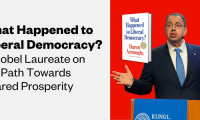
Daron Acemoglu: Building AI for Shared Prosperity

Will AI take our jobs—or spark a new era of shared prosperity? Nobel Prize winner Daron Acemoglu argues that the outcome depends on the choices leaders make now. The internationally bestselling co-author of Why Nations Fail, he shows audiences how to move beyond automating existing work and build AI that expands human capability. “I think, at the end, AI will be something that works alongside humans,” he says. “The better we understand how to achieve that, the better we will be in shaping the future of work and the future of humanity.”

Nicholas Thompson: AI Business Strategy from the Industry’s Top Minds

AI strategy is being shaped in real time by a small group of executives, researchers, and companies. Nicholas Thompson has unusual access to all of them. The CEO of The Atlantic and former editor-in-chief of WIRED, he was in the room when ChatGPT launched and regularly speaks with leaders at Google, Meta, Apple, and OpenAI. He offers a rare blend of theory and practice, helping leaders understand what AI can do now, where it may be heading, and how it will reshape competition, culture, hiring, and productivity.

Karen Hao: Democracy and the AI Arms Race

AI’s future is being shaped by a small number of companies with enormous resources and influence. In her instant New York Times bestseller Empire of AI, award-winning journalist Karen Hao draws on years of insider access to OpenAI to reveal the industry’s hidden costs, global power structures, and ideological ambitions. Her rigorous, urgent talks show audiences who controls AI, whose interests it serves, and what is at stake for democracy. Most importantly, Karen argues that today’s AI arms race is not inevitable—and that society can still choose a different path.

Why Carissa Véliz May Be the Alternative You’re Looking For

Yuval Noah Harari places AI within the vast arc of human history. Carissa Véliz offers a more focused philosophical question: why do we surrender power to people and systems that claim to predict the future? Connecting the Oracle of Delphi to Silicon Valley, she shows how ancient prophecy survives in modern algorithms—and how those predictions shape institutions, decisions, and freedom.

She Reveals the Ancient Logic Inside Modern AI

Ancient oracles claimed access to fate. Modern AI companies claim access to data. Both offer certainty—and gain power when people believe their predictions. Carissa shows how this logic has always been political, what we stand to lose by surrendering power to them, and what we stand to gain by taking back control of our choices.

She Offers a Framework for Leadership Decisions

Carissa applies her unique framework around prediction to hiring, lending, healthcare, business strategy, and AI governance. She helps leaders ask what an algorithm is predicting, what data it relies on, what it leaves out, and whose interests it serves. Her message is not to reject AI, but to use it without confusing prediction with truth or outsourcing human responsibility.

She Shows Us How to Shape the Future

We often face the future with uncertainty. But Carissa says that very uncertainty is what makes freedom possible. Instead of betting on one inevitable future, she shows leaders how to prepare for several, strengthen human judgment, and build more resilient institutions. Her message is hopeful and practical: technology is powerful, but it is not fate. The future still depends on what we choose to build.

The Quick-Scan Comparison

Speaker Core topic Speaking style Best for
Yuval Noah Harari History, AI, information, and the future of humanity Sweeping, philosophical, provocative Audiences seeking a civilization-level account of technological change
Carissa Véliz Prediction, philosophy, AI ethics, freedom, and human agency Historical, witty, philosophical, actionable Leaders and organizations asking how AI is shaping society—and how we can still shape the future
Daron Acemoglu AI, economics, democracy, work, and shared prosperity Rigorous, hopeful, practical Organizations seeking to use AI to strengthen human capability and economic inclusion
Nicholas Thompson AI strategy, technology leadership, and business Fast-moving, informed, pragmatic Executives seeking insight from the leaders and companies driving AI
Karen Hao AI industry power, OpenAI, democracy, and global inequality Investigative, urgent, evidence-rich Audiences seeking an insider’s account of the AI arms race and its social consequences

Choosing the Right AI Speaker

The right AI speaker depends on the question your audience most needs to answer. Yuval Noah Harari asks where humanity may be heading. Daron Acemoglu shows how economic and political choices can make AI work for more people. Nicholas Thompson translates developments inside the industry into business strategy. Karen Hao investigates the companies and power structures driving the AI race.

Carissa Véliz asks something more fundamental: Who gets to choose the future?

By drawing on history, philosophy, and the modern politics of technology, she shows audiences that AI is not merely a tool. It is part of a much older struggle over knowledge, authority, freedom, and who has the right to decide what comes next. Most importantly, she reminds us that the future has not been settled. We can still question the predictions being made about us, reclaim our judgment, and build a world that reflects our values rather than someone else’s prophecy.

Ready to see how Carissa Véliz can prepare your audience for the future? Learn more and watch her talks here, then get in touch to book her, or any of our other top speakers, to speak at your event.


Four Keynote Speakers Like Yuval Noah Harari

Carissa Véliz: The Ethics of AI and Prediction

For thousands of years, prophets made predictions about the future. Today, tech companies make predictions about who gets a loan, a job, an apartment, or medical care. Oxford philosopher Carissa Véliz, author of Prophecy, draws on history, philosophy, and AI ethics to show how predictions can become tools of power. In incisive, brilliant talks, she explains how AI forecasts shape behavior and erode agency—and how we can embrace uncertainty, defy the odds, and reclaim our role in building the future.

Daron Acemoglu: Building AI for Shared Prosperity

Will AI take our jobs—or spark a new era of shared prosperity? Nobel Prize winner Daron Acemoglu argues that the outcome depends on the choices leaders make now. The internationally bestselling co-author of Why Nations Fail, he shows audiences how to move beyond automating existing work and build AI that expands human capability. “I think, at the end, AI will be something that works alongside humans,” he says. “The better we understand how to achieve that, the better we will be in shaping the future of work and the future of humanity.”

Nicholas Thompson: AI Business Strategy from the Industry’s Top Minds

AI strategy is being shaped in real time by a small group of executives, researchers, and companies. Nicholas Thompson has unusual access to all of them. The CEO of The Atlantic and former editor-in-chief of WIRED, he was in the room when ChatGPT launched and regularly speaks with leaders at Google, Meta, Apple, and OpenAI. He offers a rare blend of theory and practice, helping leaders understand what AI can do now, where it may be heading, and how it will reshape competition, culture, hiring, and productivity.

Karen Hao: Democracy and the AI Arms Race

AI’s future is being shaped by a small number of companies with enormous resources and influence. In her instant New York Times bestseller Empire of AI, award-winning journalist Karen Hao draws on years of insider access to OpenAI to reveal the industry’s hidden costs, global power structures, and ideological ambitions. Her rigorous, urgent talks show audiences who controls AI, whose interests it serves, and what is at stake for democracy. Most importantly, Karen argues that today’s AI arms race is not inevitable—and that society can still choose a different path.

Why Carissa Véliz May Be the Alternative You’re Looking For

Yuval Noah Harari places AI within the vast arc of human history. Carissa Véliz offers a more focused philosophical question: why do we surrender power to people and systems that claim to predict the future? Connecting the Oracle of Delphi to Silicon Valley, she shows how ancient prophecy survives in modern algorithms—and how those predictions shape institutions, decisions, and freedom.

She Reveals the Ancient Logic Inside Modern AI

Ancient oracles claimed access to fate. Modern AI companies claim access to data. Both offer certainty—and gain power when people believe their predictions. Carissa shows how this logic has always been political, what we stand to lose by surrendering power to them, and what we stand to gain by taking back control of our choices.

She Offers a Framework for Leadership Decisions

Carissa applies her unique framework around prediction to hiring, lending, healthcare, business strategy, and AI governance. She helps leaders ask what an algorithm is predicting, what data it relies on, what it leaves out, and whose interests it serves. Her message is not to reject AI, but to use it without confusing prediction with truth or outsourcing human responsibility.

She Shows Us How to Shape the Future

We often face the future with uncertainty. But Carissa says that very uncertainty is what makes freedom possible. Instead of betting on one inevitable future, she shows leaders how to prepare for several, strengthen human judgment, and build more resilient institutions. Her message is hopeful and practical: technology is powerful, but it is not fate. The future still depends on what we choose to build.

The Quick-Scan Comparison

Speaker Core topic Speaking style Best for
Yuval Noah Harari History, AI, information, and the future of humanity Sweeping, philosophical, provocative Audiences seeking a civilization-level account of technological change
Carissa Véliz Prediction, philosophy, AI ethics, freedom, and human agency Historical, witty, philosophical, actionable Leaders and organizations asking how AI is shaping society—and how we can still shape the future
Daron Acemoglu AI, economics, democracy, work, and shared prosperity Rigorous, hopeful, practical Organizations seeking to use AI to strengthen human capability and economic inclusion
Nicholas Thompson AI strategy, technology leadership, and business Fast-moving, informed, pragmatic Executives seeking insight from the leaders and companies driving AI
Karen Hao AI industry power, OpenAI, democracy, and global inequality Investigative, urgent, evidence-rich Audiences seeking an insider’s account of the AI arms race and its social consequences

Choosing the Right AI Speaker

The right AI speaker depends on the question your audience most needs to answer. Yuval Noah Harari asks where humanity may be heading. Daron Acemoglu shows how economic and political choices can make AI work for more people. Nicholas Thompson translates developments inside the industry into business strategy. Karen Hao investigates the companies and power structures driving the AI race.

Carissa Véliz asks something more fundamental: Who gets to choose the future?

By drawing on history, philosophy, and the modern politics of technology, she shows audiences that AI is not merely a tool. It is part of a much older struggle over knowledge, authority, freedom, and who has the right to decide what comes next. Most importantly, she reminds us that the future has not been settled. We can still question the predictions being made about us, reclaim our judgment, and build a world that reflects our values rather than someone else’s prophecy.

Ready to see how Carissa Véliz can prepare your audience for the future? Learn more and watch her talks here, then get in touch to book her, or any of our other top speakers, to speak at your event.
Most Popular

FOLLOW US

UP NEXT

Setting Kids Up for Success in the Age of AI: Dana Suskind’s New Book, Human Raised

Other News