“Isabelle is a visionary who combines intellect, heart, and action. She doesn’t just ask what’s next in learning—she helps us build it, wisely.”—Sal Khan, Founder of Khan Academy
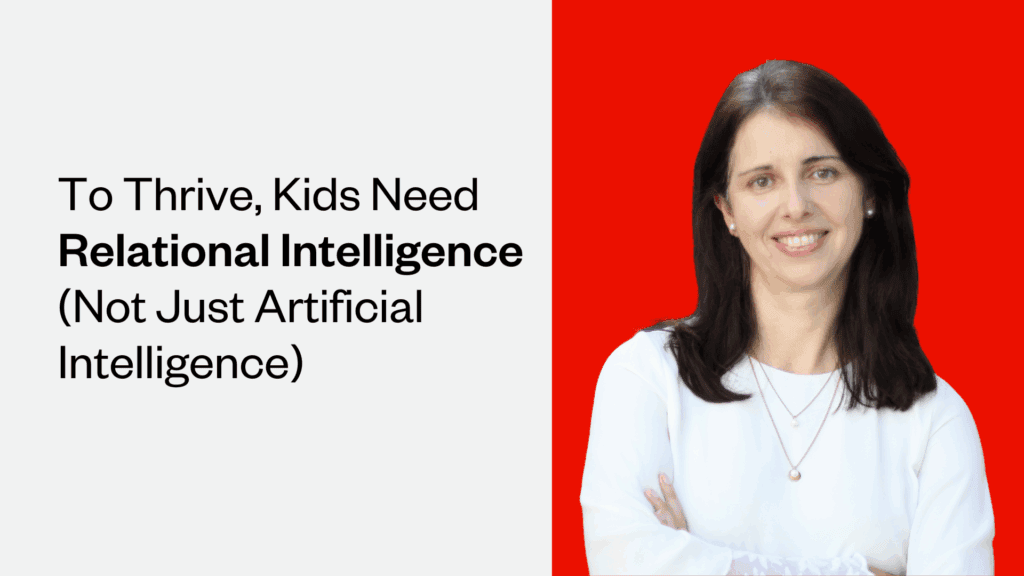
Isabelle is a go-to advisor for AI companies and the director of the world-renowned Stanford Accelerator for Learning, as well as the author of Love to Learn. She sat down with us to explain one way AI will change our children’s lives, and one way it won’t.
1. AI tools will soon saturate the education world…
“The field of education is actually the fastest adopter of AI out of all fields,” Isabelle says. There are countless use-cases for teachers and students—from interactive lessons to better communication with parents—that can make learning not only faster but better.
There are, of course, concerns: could these tools atrophy our critical thinking skills? The research is divided, Isabelle says, because the results depend deeply on the conditions under which the technology is used.
“There is a big blank space right now where educators, researchers, and innovators will need to partner a lot more closely on defining new pedagogies that will actually accelerate learning,” Isabelle says. “But it’s been really energizing to see so many educators thinking through some of the big questions that could make the education sector a lot better.”
2. …but relationships with parents and teachers will still be paramount.
“Relationships matter most in education,” Isabelle says. Parents and teachers alike play a vital role in equipping children with the relational intelligence that is becoming increasingly important in the age of AI. “Parents are the core circle of relationship. So make sure that family time is relational time,” Isabelle advises. “Being focused on relationships doesn’t mean you have to always be present—but be present at particular times, and ideally with a routine.”
And this focus on relationships will powerfully improve our children’s brain development and their ability to thrive in the new landscape of AI, Isabelle says. “With the rapid rise of artificial intelligence, we need to start thinking a lot more about what makes us human.”
Interested in hearing more from Isabelle?
Get in touch with us to learn more, and to book her to speak at your next event!
"Isabelle is a visionary who combines intellect, heart, and action. She doesn’t just ask what’s next in learning—she helps us build it, wisely."—Sal Khan, Founder of Khan Academy
Isabelle is a go-to advisor for AI companies and the director of the world-renowned Stanford Accelerator for Learning, as well as the author of Love to Learn. She sat down with us to explain one way AI will change our children’s lives, and one way it won’t.
1. AI tools will soon saturate the education world…
“The field of education is actually the fastest adopter of AI out of all fields,” Isabelle says. There are countless use-cases for teachers and students—from interactive lessons to better communication with parents—that can make learning not only faster but better.
There are, of course, concerns: could these tools atrophy our critical thinking skills? The research is divided, Isabelle says, because the results depend deeply on the conditions under which the technology is used.
“There is a big blank space right now where educators, researchers, and innovators will need to partner a lot more closely on defining new pedagogies that will actually accelerate learning,” Isabelle says. “But it’s been really energizing to see so many educators thinking through some of the big questions that could make the education sector a lot better.”
2. …but relationships with parents and teachers will still be paramount.
“Relationships matter most in education,” Isabelle says. Parents and teachers alike play a vital role in equipping children with the relational intelligence that is becoming increasingly important in the age of AI. “Parents are the core circle of relationship. So make sure that family time is relational time,” Isabelle advises. “Being focused on relationships doesn’t mean you have to always be present—but be present at particular times, and ideally with a routine.”
And this focus on relationships will powerfully improve our children’s brain development and their ability to thrive in the new landscape of AI, Isabelle says. “With the rapid rise of artificial intelligence, we need to start thinking a lot more about what makes us human.”
Interested in hearing more from Isabelle?
Get in touch with us to learn more, and to book her to speak at your next event!