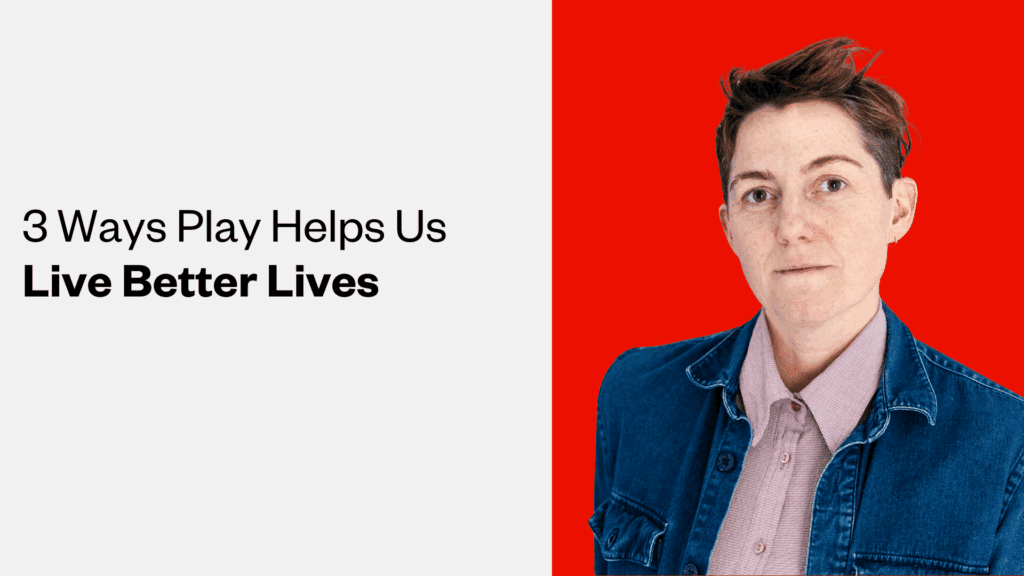
It’s Time to Start Playing Again: Designer Cas Holman on 3 Ways Play Helps Us Live Better Lives
Burned out, stressed, or just plain tired? What if the secret to greater wellbeing isn’t another productivity hack, but something far more intuitive: play? “If we can play together, we can live together,” says Cas Holman, world-renowned toy designer and author of the vital new book Playful. Cas argues that rediscovering the fundamental human instinct to play is not just about having fun. It’s about building a richer, more connected, and more innovative existence, both individually and collectively. In a world that prioritizes constant productivity and efficiency, we’ve sidelined the essential role play holds in our adult lives. But embracing a playful mindset could be the most strategic step for enhanced personal well-being, creative capacity, and deeper connections. Cas sat down with us on our podcast, Lavin Voices, to show us 3 ways play helps us live better lives. Find her insights below, and get in touch to book her to speak at your event!
1. Play boosts our wellbeing.
One reason we hesitate to play, Cas explains, is the belief that “we need to be productive or efficient all the time.” There’s a common misconception that engaging in social connections or activities without a direct, measurable output is “less productive.” But, as humans, we are intrinsically wired to thrive on connection and moments of genuine, unburdened engagement.
Cas hesitates to say play is productive in the conventional sense. However, she argues that “if we understand the value of play, then we’ll understand that it is productive: in making us feel good and be human and connect with the people that are in the space around us.” When we allow ourselves these often-overlooked moments—a spontaneous conversation, a beloved hobby, or simply rearranging our personal space—we fulfill a deep-seated need. Rethinking our definition of productivity is key to unlocking our wellbeing.
2. Play boosts our creativity.
Beyond cultivating personal well-being, play can be a powerful engine for creativity and innovative problem-solving. Studies have showed that rats in enriched environments who were given opportunities to play developed brains faster than rats who weren’t given the same opportunities. Notably, college students who engaged in just five minutes of play with puzzles before a challenging problem higher on problem-solving—and found the problems more engaging too.
Play encourages us to explore diverse outcomes, Cas says, making us “much more available to see opportunity and failure.” It is within the challenge, within the “friction,” that our cognitive faculties are sparked, leading to a deeper involvement in discovering novel solutions.
3. Play boosts our connection.
Perhaps most important in our complex world, play stands as an unparalleled tool for fostering genuine connection and mutual understanding. “I don’t think people are super happy right now,” Cas says. “We’re certainly not getting along. But if we can play together, we can live together.”
Consider the dynamic of a casual pickup basketball game. Players might be competitive, even verbally sparring, yet they walk away as friends. They have engaged, coexisted, navigated minor conflicts, and fostered respect within shared rules of play. Whether through formal games or the organic process of making up rules on the fly, play teaches negotiation, compromise, and the invaluable ability to “figure it out” collaboratively. In these shared experiences, we learn that “there can be conflict and we can come out of it and keep playing together,” Cas says.
It’s time for us to rethink play: not as a trivial pastime or a diversion, but as a human imperative that boosts personal well-being, ignites creative problem-solving, and strengthens our communities. We can start by integrating intentional moments of play into our lives—starting today!
Want more from Cas?
Watch her Lavin Voices episode below, and then get in touch to book her to speak at your event!
1. Play boosts our wellbeing.
One reason we hesitate to play, Cas explains, is the belief that "we need to be productive or efficient all the time." There's a common misconception that engaging in social connections or activities without a direct, measurable output is "less productive." But, as humans, we are intrinsically wired to thrive on connection and moments of genuine, unburdened engagement.
Cas hesitates to say play is productive in the conventional sense. However, she argues that "if we understand the value of play, then we'll understand that it is productive: in making us feel good and be human and connect with the people that are in the space around us." When we allow ourselves these often-overlooked moments—a spontaneous conversation, a beloved hobby, or simply rearranging our personal space—we fulfill a deep-seated need. Rethinking our definition of productivity is key to unlocking our wellbeing.
2. Play boosts our creativity.
Beyond cultivating personal well-being, play can be a powerful engine for creativity and innovative problem-solving. Studies have showed that rats in enriched environments who were given opportunities to play developed brains faster than rats who weren't given the same opportunities. Notably, college students who engaged in just five minutes of play with puzzles before a challenging problem higher on problem-solving—and found the problems more engaging too.
Play encourages us to explore diverse outcomes, Cas says, making us "much more available to see opportunity and failure." It is within the challenge, within the "friction," that our cognitive faculties are sparked, leading to a deeper involvement in discovering novel solutions.
3. Play boosts our connection.
Perhaps most important in our complex world, play stands as an unparalleled tool for fostering genuine connection and mutual understanding. "I don't think people are super happy right now," Cas says. "We're certainly not getting along. But if we can play together, we can live together."
Consider the dynamic of a casual pickup basketball game. Players might be competitive, even verbally sparring, yet they walk away as friends. They have engaged, coexisted, navigated minor conflicts, and fostered respect within shared rules of play. Whether through formal games or the organic process of making up rules on the fly, play teaches negotiation, compromise, and the invaluable ability to "figure it out" collaboratively. In these shared experiences, we learn that "there can be conflict and we can come out of it and keep playing together," Cas says.
It’s time for us to rethink play: not as a trivial pastime or a diversion, but as a human imperative that boosts personal well-being, ignites creative problem-solving, and strengthens our communities. We can start by integrating intentional moments of play into our lives—starting today!
Want more from Cas?
Watch her Lavin Voices episode below, and then get in touch to book her to speak at your event!