

The Lavin Agency Speakers Bureau
A speakers bureau that represents the best original thinkers,
writers, and doers for speaking engagements.
A speakers bureau that represents the best original thinkers,
writers, and doers for speaking engagements.
AI isn't a threat to art, or a replacement for human artists, but a brand new kind of art form. Paired with our own creativity, it can be used to preserve and appreciate the vastness of human life.
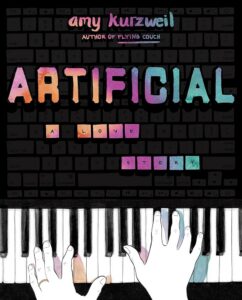
Can AI and art coexist? Amy Kurzweil says yes. Not only that, but AI can act as a brand new art form (“a weird and interesting kind of paint”) that unlocks new possibilities for human creativity, memory, and even legacy. A New Yorker cartoonist, Amy set out with her father, the futurist Ray Kurzweil, to connect with the grandfather she never met by building a chatbot that writes in his voice. She documented their quest—and what it taught her about the powerful combination of AI and creativity—in her award-winning memoir Artificial: A Love Story, which The Boston Globe calls “a breathtaking graphic memoir [and] a meditation on how art, technology, and memory keep people alive.” At a moment where AI seems poised to disrupt how we work, how we live, and how we make meaning, Amy’s intimate, funny talks offer audiences a new framework for integrating this new technology into our lives while maintaining our connection to what’s essentially human.
Amy Kurzweil is a New Yorker cartoonist, writer, and teacher whose work explores memory, identity, technology, and AI. Her TED Talk, “Time Traveling With AI to Connect With Lost Loved Ones,” has been viewed over half a million times.
She is the author of two award-winning graphic memoirs. Her most recent work, Artificial: A Love Story, was named a best book of 2023 by NPR, Kirkus and The New Yorker. It tells the story of Amy’s experience spending many years engrossed in the archives of her grandfather, whom she never met, in order to help build a (pre-ChatGPT) large language model that engaged with his writing. With her signature humanity and humor, as well as her gorgeous handmade drawings, Amy offers a look into three generations of her family’s history. It’s a unique exploration into how we relate to one another, how technology can enable our creativity, and what a meaningful life really looks like. In a starred review, Library Journal writes that “Kurzweil’s highly recommended memoir is unlike any other. It will leave readers with much to contemplate.”
Her first graphic memoir, Flying Couch, was a New York Times ‘Editor’s Choice’ and a Kirkus best nonfiction book of 2016. In it, Amy weaves her own coming-of-age story with the narrative of her mother, a psychologist, and her grandmother, a World War II survivor who escaped from the Warsaw Ghetto at age 13. In a starred review, Kirkus calls it “a debut that enriches and extends the potential of graphic narrative,” while LitReactor praises it as “wry and deeply moving.”
Amy is the winner of the Overseas Press Club’s 2024 “Best Cartoon” Award for her work with The LA Times. She’s been nominated for Reuben and Ignatz Awards for “Technofeelia,” her four part series with The Believer Magazine about human adventures in technology. She was a 2021 Berlin Prize Fellow at the American Academy in Berlin, a Black Mountain Institute Shearing Fellow, a Yaddo Fellow, and a MacDowell Fellow. Her comics and graphic essays have also been published in The New York Times Book Review, The Verge, Wired, and many other places. She has taught writing and comics at the Parsons School of Design in New York City, The Fashion Institute of Technology, Center for Talented Youth, Interlochen Center for the Arts, in New York City Public Schools, and in many other venues.

Author of The Loop: How A.I. is Creating a World without Choices and How to Fight Back NBC News Technology Correspondent Former Editor-in-Chief of Popular Science Magazine AI Strategic Advisor to Fortune 500 Companies

Founding President, PlusCo Venture Studio Former Chief Creative and Innovation Officer, Cossette

Speaker on AI and Education Executive Director of the Stanford Accelerator for Learning

Featured Artist in the Top 10 Netflix Documentary Secret Mall Apartment Tape Art Founder

Author, How Great Ideas Happen Cognitive Scientist at The University of Toronto

Founding President, PlusCo Venture Studio Former Chief Creative and Innovation Officer, Cossette

#1 New York Times Bestselling Author of Grit and Situated | Pioneering Researcher on Grit, Perseverance, and the Science of Success

Nobel Prize Winner | 3rd Most Cited Economist in the World | Bestselling Co-Author of Why Nations Fail and Power and Progress

Harvard Business School Behavioral Science Professor | "40 Under 40 MBA Professor" | Author of TALK: The Science of Conversation and the Art of Being Ourselves

#1 New York Times Bestselling Co-Author of Abundance | Host of thePlain English Podcast | CBS News Contributor

#1 New York Times Bestselling Author of How the Word Is Passed and Above Ground | The Atlantic Staff Writer

AI isn’t a threat to human creativity, but a new and interesting kind of paint, says Amy Kurzweil. In this utterly unique and unforgettable talk, she uses her family’s multi-generational story of exile and survival as a lens to explore the intersection of AI, art, human creativity, personal history, and collective memory.
With humor, playfulness, and as big a screen as you can offer, Amy takes audiences through the mission of her father, inventor and futurist Ray Kurzweil, to “resurrect” his own father through AI and his original writing, as well as her role as an artist and archivist of human data. She explores philosophical questions about the nature of human memory and identity, and offers a compelling framework for understanding AI as artistic representation: a tool that can help us memorialize the past while envisioning our collective future.
This talk is immersive and visually rich, featuring lush, handmade drawings. Through her distinctive cartoon world, Amy captures the emotional dimension of our AI moment: a human hand grappling with her unique machine past and our collective machine future. Audiences leave with a deeper understanding of how to remain fully human in an age of digital artifice.