


The Lavin Agency Speakers Bureau
A speakers bureau that represents the best original thinkers,
writers, and doers for speaking engagements.
A speakers bureau that represents the best original thinkers,
writers, and doers for speaking engagements.
The legacy of slavery still shapes our cities, roads, and stories today. Understanding our history will help us make sense of our world—and fight for a better one.
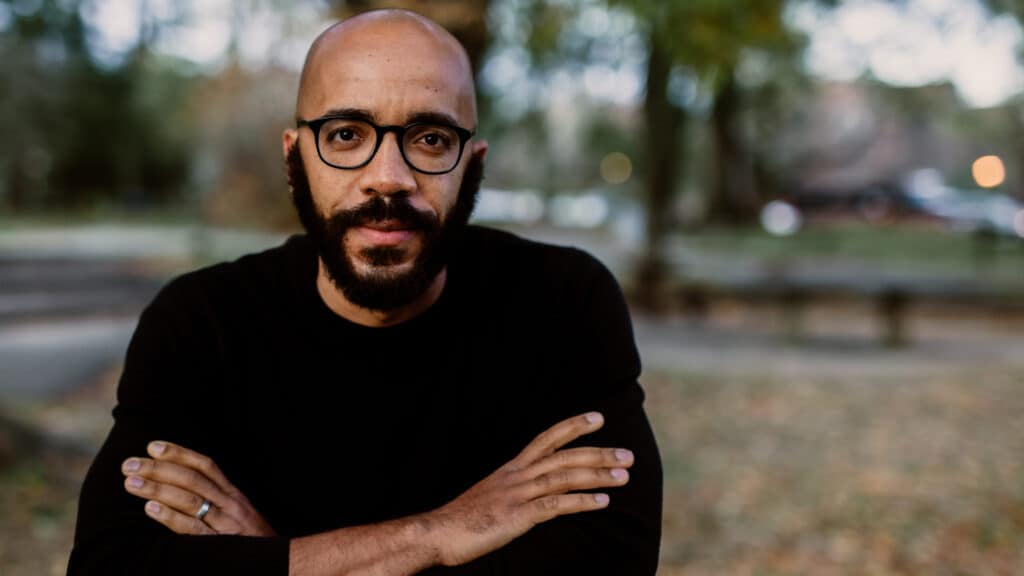
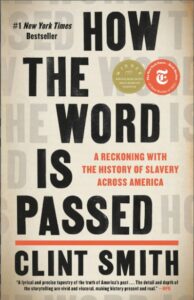
Our understanding of Black American history has been incomplete for a long time. But “how you once told the story doesn’t have to be how you tell the story forever,” says Clint Smith. In his #1 New York Times bestseller How the Word Is Passed, Clint explores the legacy and narratives of slavery around different historical sites like old plantations where enslaved people worked, and offers a compelling, nuanced perspective on the history of this country. One of The NYT’s 10 Best Books of the Year, How the Word Is Passed was called “an extraordinary contribution to the way we understand ourselves” by the New York Times Book Review. In talks, Clint challenges us to reckon with our past “honestly, proactively, and precisely.” When we recognize the ecosystem of stories that influence our understanding of history, he says, we can better make sense of the world we live in today—and choose to build a better world for those who come after us.
The detail and depth of the storytelling is vivid and visceral, making history present and real. Smith deftly connects the past, hiding in plain sight, with today’s lingering effects. — NPR
A staff writer at The Atlantic and the #1 New York Times bestselling author of How the Word Is Passed, Clint Smith is revolutionizing how we understand the history of our country, the physical places where we live, and the stories we tell about the world around us. Through his vital writing and talks, he argues that understanding our history not only enables us to understand our world, but also empowers us to fight for racial justice.
“From the moment enslaved people arrived on these shores, they were fighting for freedom,” he says. “The vast majority of people who fought for freedom never got a chance to experience it for themselves. But they fought for it anyway, because they knew that someday, someone would. What kind of responsibility does that bestow upon us? To attempt to build the sort of world that we might not see ourselves, because that’s what was done for us.”
Clint’s bestselling books include How the Word Is Passed, which Publishers Weekly called “an essential consideration of how America’s past informs its present.” In it, Clint takes us on a journey through landmarks that are both honest and dishonest about the past, offering a sweeping yet personal history of how slavery has shaped our country and ourselves. It has won numerous awards, including the National Book Critics Circle Award for Nonfiction, and was named one of the best books of the year by TIME, The New York Times, The Economist, The Washington Post, and many more.
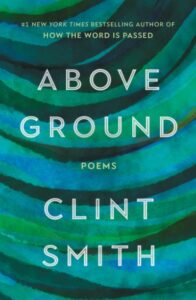
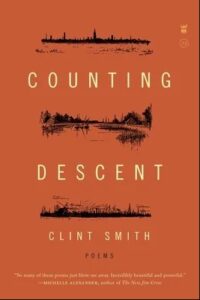
His latest book, Above Ground, was named to TIME magazine’s 100 Must-Read Books and NPR‘s Books We Love. A vibrant poetry collection that traverses the vast emotional terrain of fatherhood, TIME called it “a beautiful meditation not only on Smith’s own journey as a dad, but also on the effect our ever-changing world has on the way we raise our children.” Clint’s first book, Counting Descent, won the 2017 Literary Award for Best Poetry Book from the Black Caucus of the American Library Association and was a finalist for an NAACP Image Award.
In his forthcoming book Just Beneath the Soil, the first of a three book deal with Penguin Random House, Clint will explore the little-known stories behind World War II sites, and discuss how they shape our collective memory of the war. He will focus on people whose stories are often at the periphery of our dominant narrative of the conflict.
Clint received his PhD in Education from Harvard University. He has received fellowships from the Andrew W. Mellon Foundation, New America, the Emerson Collective, the Art For Justice Fund, Cave Canem, and the National Science Foundation. His essays, poems, and scholarly writing have been published in The New Yorker, The New York Times Magazine, The New Republic, Poetry Magazine, The Paris Review, the Harvard Educational Review, and many more. He is a former National Poetry Slam champion and a recipient of the Jerome J. Shestack Prize from the American Poetry Review.
Clint was incredible. Several people (myself included) thought he was the best speaker The Jung Center has ever had—and that is a big compliment because we have had some really top-notch speakers. One attendee said he was "allergic to mindfulness" before the event. Afterward, he bought all of Clint's books and says he is "diving into mindfulness". A great outcome!!
The Jung CenterDr. Clint Smith was a resounding success! He was superb. He dazzled and captivated the attendees with an amazing presentation of the impact and effect of slavery. We highly recommend Clint Smith.
Urban League of Hampton RoadsThe talk was just amazing and he was such a delight to work with! We sold out in-person audience with additional people registering through Zoom, for a total of over a thousand attendees. It is the largest online attendance we have had for a program in years. In addition, all of his books sold out.
Virginia Museum of Fine Arts
Harvard Economist MacArthur Genius Studying Economic Opportunity Director of Opportunity Insights

Historian New York Times Bestselling Author of Humankind: A Hopeful History, Utopia for Realists, and Moral Ambition

Author of Morningside and THE AMERICANO

Speaker on AI and Education Executive Director of the Stanford Accelerator for Learning

Harvard Business School Behavioral Science Professor "40 Under 40 MBA Professor" Author of TALK: The Science of Conversation and the Art of Being Ourselves

Author, Ordinary Magic Co-Director, Dweck-Walton Lab at Stanford Professor of Psychology, Stanford

Harvard Economist MacArthur Genius Studying Economic Opportunity Director of Opportunity Insights

Author of Indivisible: How to Forge Our Differences into a Stronger Future Founder and CEO of WatchHerWork

Author of The 272: The Families who Were Enslaved and Sold to Build the American Catholic Church Tenured Professor at New York University Former New York Times Johannesburg Bureau Chief

Author of Grit, the #1 New York Times Bestseller | Pioneering Researcher on Grit, Perseverance, and the Science of Success

2024 Nobel Prize Winner | 3rd Most Cited Economist in the World | Bestselling Co-Author of Why Nations Fail and Power and Progress

Harvard Business School Behavioral Science Professor | "40 Under 40 MBA Professor" | Author of TALK: The Science of Conversation and the Art of Being Ourselves

#1 New York Times Bestselling Co-Author of Abundance | Host of thePlain English Podcast | Founder of the Substack Derek Thompson

#1 New York Times Bestselling Author of How the Word Is Passed and Above Ground | The Atlantic Staff Writer

Across the country are innumerable places that have direct ties to slavery—our schools, our streets, our prisons, our cemeteries, our cities—places that illustrate how some of this country’s most essential stories are hidden in plain view. In this talk, #1 New York Times bestselling author Clint Smith discusses how the history of slavery has shaped the contemporary landscape of inequality, and shares what he learned from trips to different historical sites throughout the country that are tied to slavery’s legacy.
Informed by scholarship and brought alive by the stories of people living today, Clint’s talk outlines how these places reckon with—or fail to reckon with—their relationship to slavery, and how it is our responsibility to collectively document, learn from, and account for this history. Drawing on his award-winning book, How the Word Is Passed, he shows how the history we tell ourselves was a long time ago really wasn’t that long ago at all. Audiences will walk away understanding not only how our country became like this, but where we go from here.

America is a place that has provided unparalleled opportunities and upward mobility for millions of people across generations in ways that their ancestors could have never imagined. And it has often done so, at the direct expenses of millions of other people across generations who have been systematically exploited and oppressed. America is a place that has given and a place that has taken away. It is the Freedom Bell, and is is the enslaver’s whip. It is manifest destiny, and it is the Trail of Tears. It is what Thomas Jefferson wrote, and it is what Jefferson did.
In this powerful, far-ranging talk, #1 New York Times bestselling author Clint Smith reveals how the story of America is one of complexity, of contradictions, and of cognitive dissonance. There is no single American story, he says—there are many. In order to understand America, we must hold all of these stories alongside one another—and we must be honest about them—in order to truly understand our country’s history, and how it shapes the society we are a part of today. Audiences walk away with a greater understanding of who we are, who we have been, and who we could be.

Clint Smith traveled to six locations around the world to learn how citizens memorialize the war that remade their global order. In this powerful talk, he reveals what he discovered.
For his book Just Beneath the Soil: How We Remember World War II, Clint spent time at monuments, memorials, museums, and historical sites alongside people who carry that history in their blood—the atomic bomb survivor, the Holocaust survivor, the Japanese internment camp survivor, the surviving Korean “comfort woman,” and the Navajo Code Talker. Each conversation with a survivor, as well as their descendants, took these histories out of the realm of abstraction and made them real. Their narratives took a decades-old history and made him proximate to that pain. The past was on their breath. The stories were in their hands. The history was in the creases of their faces. Soon, however, there will be no survivors left. And the question that stayed with him as he visited each place was: what happens after they die? What can we do to keep this awareness, of war’s true meaning, alive? Are the memorials that we have built to remind of us of the horror these survivors witnessed enough to prevent us from falling back into cycle that led us to 1939?
In this talk, audiences learn more about how these memorials, museums, and historical sites are a way of preserving memory and enhancing our proximity to the past, so that it never becomes an abstraction we can easily ignore. Along with the audience, Clint examines whether these memorials retain enough moral, spiritual force to act as a proxy for those who lived through this violence. Are these statues and stones enough to keep us from doing it again?
The world we live in is changing faster than ever before. How do we grow and find our footing? In this talk, Clint Smith reads and discusses poems from his New York Times bestselling collection of poetry, Above Ground. There are poems that interrogate the ways our lives are shaped by both personal lineages and historical institutions. There are poems that revel in the wonder of discovering the world anew through the eyes of your children, as they discover it for the first time. There are poems that meditate on what it means to raise a family in a world filled with constant social and political tumult.
Above Ground wrestles with how we hold wonder and despair in the same hands, how we carry intimate moments of joy and a collective sense of mourning in the same body. Clint’s lyrical, narrative poems and insightful discussions bring the reader on a journey not only through the early years of his children’s lives, but through the changing world in which they are growing up—through the changing world of which we are all a part.
Being a teacher has never simply been about pedagogy or lesson plans. Teachers are in a unique position right now to help their students understand that the state of the world is not an inevitability, and that we shouldn’t accept it as such. They can help their students understand that the inequality we see across the world was created and constructed—and thus it can be deconstructed and reconstructed to build something better, something more just.
In this fireside chat, Clint Smith provides teachers with the framework and the tools to approach these conversations in their schools. A former English teacher and host of the YouTube series Crash Course Black American History, Clint offers his expertise and personal experience to audiences in education, encouraging them to use their classrooms as spaces of transformation to help students dream of building a better world.