Turn AI Into a “Force-Multiplier” for Human Expertise. A Nobel-Winning Economist’s 2 Tips for Making AI Work for Us (And for Our Democracy)
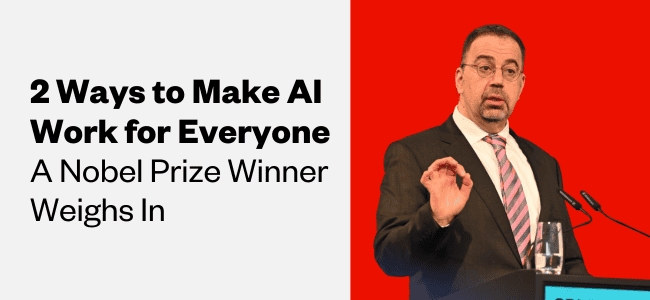
Will AI take our jobs? Or will it spark a new age of shared prosperity? The answer, says Daron Acemoglu, is in our hands. A long-time Lavin Exclusive Speaker, Daron is a Nobel Prize winner and one of the world’s top voices on the relationship between AI, progress, and democracy. In hopeful talks, he shows us how to build a world where AI acts as a “force-multiplier” for human expertise: improving productivity, reducing inequality, and enabling better lives for all of us. He offers 2 tips that we can use to make AI work for everyone. Find them below, and get in touch to book him to speak at your event!
Daron won the 2024 Nobel Prize in Economics alongside collaborators James Robinson (a fellow Lavin Exclusive Speaker) and Simon Johnson. He is the internationally bestselling co-author of Why Nations Fail (with James Robinson) and Power and Progress (with Simon Johnson). Below, he explains 2 ways leaders can maximize productivity, unlock new capabilities, and build shared prosperity.
1. Stop automating old tasks. Start creating new ones.
When presented with new AI tools, most organizations immediately start to automate their workers’ existing tasks—”that just seems to be the path of least resistance,” Daron tells the MIT Sloan Management Review. And while that might help us save money, we’re not actually expanding what our organizations are capable of doing.
To turn AI into a true “force-multiplier,” we must pivot toward creating new tasks that were previously impossible for human workers to achieve. Imagine a junior electrician who, equipped with a custom AI tool, can suddenly troubleshoot a complex piece of equipment with the precision of a 30-year veteran. “We can significantly improve what electricians, nurses, educators, journalists, academics could do using AI,” Daron says.
2. Build tools that empower individuals, not accumulate data.
In order to unlock this expanded capability, we need tools that are specific to our work. You could ask ChatGPT for help—but it’s unreliable, hasn’t been designed for that task, and hasn’t been trained on high-quality data. Asking a tool like that to come up with an answer for you is a recipe for disaster.
But what if we could build a reliable, domain-specific tool that leverages AI pattern recognition and human expertise? That would not only make the worker more productive, but also make their skills more valuable and allow them a piece of the shared prosperity that underpins a healthy democracy. “I think, at the end, AI will be something that works alongside humans,” Daron says. “The better we understand that and how to achieve that, the better we will be in shaping the future of work and the future of humanity.”
Want more from Daron?
Learn more about him here, then contact us to book him to speak at your event!
Daron won the 2024 Nobel Prize in Economics alongside collaborators James Robinson (a fellow Lavin Exclusive Speaker) and Simon Johnson. He is the internationally bestselling co-author of Why Nations Fail (with James Robinson) and Power and Progress (with Simon Johnson). Below, he explains 2 ways leaders can maximize productivity, unlock new capabilities, and build shared prosperity.
1. Stop automating old tasks. Start creating new ones.
When presented with new AI tools, most organizations immediately start to automate their workers' existing tasks—"that just seems to be the path of least resistance," Daron tells the MIT Sloan Management Review. And while that might help us save money, we're not actually expanding what our organizations are capable of doing.
To turn AI into a true "force-multiplier," we must pivot toward creating new tasks that were previously impossible for human workers to achieve. Imagine a junior electrician who, equipped with a custom AI tool, can suddenly troubleshoot a complex piece of equipment with the precision of a 30-year veteran. "We can significantly improve what electricians, nurses, educators, journalists, academics could do using AI," Daron says.
2. Build tools that empower individuals, not accumulate data.
In order to unlock this expanded capability, we need tools that are specific to our work. You could ask ChatGPT for help—but it's unreliable, hasn't been designed for that task, and hasn't been trained on high-quality data. Asking a tool like that to come up with an answer for you is a recipe for disaster.
But what if we could build a reliable, domain-specific tool that leverages AI pattern recognition and human expertise? That would not only make the worker more productive, but also make their skills more valuable and allow them a piece of the shared prosperity that underpins a healthy democracy. "I think, at the end, AI will be something that works alongside humans," Daron says. "The better we understand that and how to achieve that, the better we will be in shaping the future of work and the future of humanity."
Want more from Daron?
Learn more about him here, then contact us to book him to speak at your event!
https://www.youtube.com/watch?v=ujWqZZLaA74&feature=youtu.be