How to Lead by Listening: Virtuoso Violinist Vijay Gupta’s New Memoir, Restrung
By the time he was 25, celebrated violinist Vijay Gupta had played Carnegie Hall, studied at Juilliard and Yale, joined the Los Angeles Philharmonic, and given a TED Talk seen by millions. But behind the scenes, he was burning out. Finding his way back required him to rediscover the music he loved and chart a new path towards hope. This Lavin Exclusive Speaker’s memoir, Restrung, is out now! Seth Godin calls it “a journey through music and love and possibility that might change your life.” In talks, Vijay draws on his story to offer a roadmap to creativity and connection for audiences of all backgrounds.
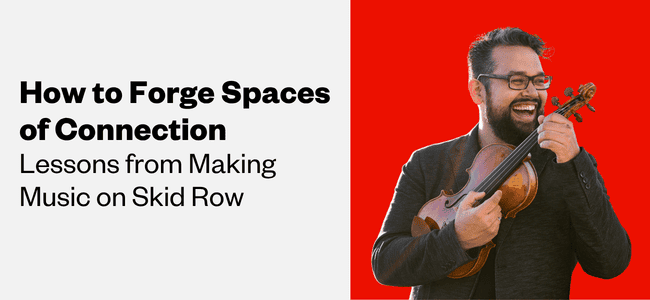
An internationally celebrated violinist and founder of Street Symphony—the nonprofit that brings music into shelters, jails, and reentry programs across Los Angeles—Vijay has spent his career at the intersection of art, justice, and healing. Restrung is his memoir of finding purpose, connection, dignity, and survival through the medicine of music. Below, find two insights he offers in his personal, hopeful talks.
1. Learn to listen.
Early in his career, Vijay played a 15-minute piece by Bach—”the violinist’s Mount Everest”—for 300 incarcerated people in a state hospital. He thought it was going well… but when he finished, he was met only by silence. A man stood up and said, “Son, don’t you know any songs we know?”
Vijay froze. “And I think he took pity on me,” he says. “He sang back to me: a song called ‘Jesus on the Mainline.'” And the room joined in. “I thought about this episode for years as a kind of musical failing,” Vijay says. “But actually, that’s not the problem. What this man was saying is, ‘Do you see me? Do you see my humanity? Or are you just playing for yourself?'”
When we’re talking to others, Vijay says, there’s often a “fourth wall”: a veneer of professionalism that doesn’t allow us to break through and be human to the person we’re talking to. For real, human connection, we need to break down that wall—and learn to listen.
2. Learn to accompany.
“There’s a concept in son jarocho music called compromiso,” Vijay says. “It’s the artist’s promise: literally com-promiso. The com is the shared experience: of community, compassion, accompaniment. But the promise is the artist’s work of practicing in solitude, getting better at our craft, and then offering that craft to the world without question. Instead of seeing practice as a one-way delivery of music, I now see it as an exchange.”
Often, Vijay says, we go into situations assuming we’re there to offer help or information. But sometimes, what people need is someone to accompany them. “Accompany means to walk with, to attend with,” he says. “My organization, Street Symphony, is an act of musical accompaniment. I cannot name or even advocate for the personal healing of every one of the individuals who cross through the Midnight Mission or the Downtown Women’s Center, or the prisons or county jails where we play—but I can commit to walk with them.”
Want more from Vijay?
Learn more about him here, then contact us to book him to speak at your event!
An internationally celebrated violinist and founder of Street Symphony—the nonprofit that brings music into shelters, jails, and reentry programs across Los Angeles—Vijay has spent his career at the intersection of art, justice, and healing. Restrung is his memoir of finding purpose, connection, dignity, and survival through the medicine of music. Below, find two insights he offers in his personal, hopeful talks.
1. Learn to listen.
Early in his career, Vijay played a 15-minute piece by Bach—"the violinist's Mount Everest"—for 300 incarcerated people in a state hospital. He thought it was going well... but when he finished, he was met only by silence. A man stood up and said, "Son, don't you know any songs we know?"
Vijay froze. "And I think he took pity on me," he says. "He sang back to me: a song called 'Jesus on the Mainline.'" And the room joined in. "I thought about this episode for years as a kind of musical failing," Vijay says. "But actually, that's not the problem. What this man was saying is, 'Do you see me? Do you see my humanity? Or are you just playing for yourself?'"
When we're talking to others, Vijay says, there's often a "fourth wall": a veneer of professionalism that doesn't allow us to break through and be human to the person we're talking to. For real, human connection, we need to break down that wall—and learn to listen.
2. Learn to accompany.
"There's a concept in son jarocho music called compromiso," Vijay says. "It's the artist's promise: literally com-promiso. The com is the shared experience: of community, compassion, accompaniment. But the promise is the artist's work of practicing in solitude, getting better at our craft, and then offering that craft to the world without question. Instead of seeing practice as a one-way delivery of music, I now see it as an exchange."
Often, Vijay says, we go into situations assuming we're there to offer help or information. But sometimes, what people need is someone to accompany them. "Accompany means to walk with, to attend with," he says. "My organization, Street Symphony, is an act of musical accompaniment. I cannot name or even advocate for the personal healing of every one of the individuals who cross through the Midnight Mission or the Downtown Women's Center, or the prisons or county jails where we play—but I can commit to walk with them."
Want more from Vijay?
Learn more about him here, then contact us to book him to speak at your event!
https://youtu.be/AnPUDIov_Ac?si=Fw0ck7uYbwHmC7q4