









Kathryn Paige Harden

Our genes and environment shape who we become. Understanding them can help us create a truly just and equal society.

Professor of Psychology, University of Texas at Austin | Director, Developmental Behavior Genetics Lab | Author, Original Sin

Play VideoNow Playing

If You Show Me Your DNA, Can I Tell You Who You Are? (29:21)

Play VideoNow Playing

Why DNA matters for social equality (1:07:23)

Lavin Exclusive Speaker

How do our genetics shape who we become? And can they help us understand one another and forge a fairer, more equal society? Kathryn Paige Harden has spent her career exploring questions like these with nuance and a scientist’s rigor. Paige is a professor of psychology at the University of Texas, Austin, where she has directed the Developmental Behavior Genetics Lab for over 15 years, and the author of Original Sin: “a daring, complex, [and] powerful tapestry of a book” (The New York Times Book Review) and “the very best of science writing” (Adam Rutherford). In honest, human talks based on her cutting-edge research, she offers a new framework of genes as “moral luck”: one of countless arbitrary inequalities we’re born into, and one that doesn’t have to dictate our success, dignity, or happiness. Understanding how our genes shape our paths, she says, is the first step to pursuing true justice, reimagining accountability and forgiveness, and creating a more equal world.

Dr. Kathryn Paige Harden is a professor of psychology at the University of Texas at Austin, where she directs the Developmental Behavior Genetics lab. Paige is a graduate of Furman University and the University of Virginia. She has been profiled in The New Yorker, has spoken at MIT, Princeton, the Max Planck Institute, the Royal Institution, and SXSW, and has published over 150 scientific papers on the nature and nurture of human behavior. Her books have been translated into 10 languages and her research and writing have been featured in The New York Times, The Guardian, The Economist, Science, and more.

Her most recent book is Original Sin: On the Genetics of Vice, the Problem of Blame, and the Future of Forgiveness. Called “ambitious, compact, and often moving” (Science), Original Sin is “an extraordinary book, the very best of science writing” (Adam Rutherford, author of A Brief History of Everyone Who Ever Lived). In it, Paige grapples with some of the most important questions in modern life: How do we take responsibility for the people we become, knowing how we are shaped by both biology and experience? How should we respond when people hurt each other—or themselves? And she challenges us to imagine a more humane vision of accountability—for ourselves and for one another.

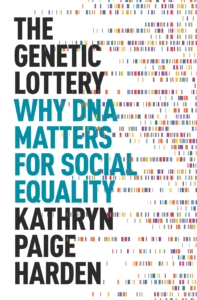
Her first book, The Genetic Lottery, introduces readers to the latest genetic science, dismantling dangerous ideas about racial superiority and challenging us to wrestle through what equality really means in a world where people are born different. Weaving together personal stories with scientific evidence, Paige argues that we must acknowledge the role of genetic luck if we are ever to create a fair society, and offers a bold new vision of society where everyone thrives, regardless of how one fares in the genetic lottery.

Speech Topics

STEM
Original SinGenetics and a New Framework for Accountability and Forgiveness

How much choice do we really have over the people we become? And how should we treat each other—even people who have done horrible things—knowing that no one has fully chosen to be themselves?

Kathryn Paige Harden is a behavioral geneticist whose research analyzes the DNA of millions of people—and an ex-Evangelical who reads Augustine alongside the latest scientific papers. Drawing on her book Original Sin, she explores what the science of human behavior means for how we blame, punish, and forgive.

In this powerful, science-backed, deeply humane talk, Paige brings a rare combination of scientific authority and moral seriousness to one of the most urgent questions of our time: how to understand the role that genetics plays in the outcomes of our lives, and how to use that knowledge to forge a truly just world. Audiences leave with a new framework of “genes as moral luck” and a renewed imagination for accountability and forgiveness. They walk away thinking differently about the binary ideas that usually structure these debates—nature vs. nurture, constraint vs. choice, punishment vs. forgiveness—and with a greater imagination for thinking about dignity, accountability, and responsibility in their families, workplaces, schools, and communities.

Read more

Featured Books

Other News