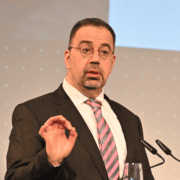
Daron is a Lavin Exclusive Speaker, MIT Institute Professor, and winner of the 2024 Nobel Prize in Economics. In What Happened to Liberal Democracy? (his first book since the Nobel), as well as sweeping, deeply researched keynotes, he draws on economics, history, and political theory to explain how liberal democracy lost its way—and how we can rebuild a system that delivers stronger institutions, empowered communities, and prosperity for all. Below, find three strategies Daron says will help us move forward:
Rebuild strong communities.
Liberalism is often associated with individual freedom. But freedom doesn’t exist in isolation, Daron argues. We learn from one another, govern together, and build knowledge through the communities we belong to. “Community is woven into our nature,” Daron writes. Rebuilding liberal democracy will require us to rebuild the places where people encounter one another, exchange ideas, solve problems, and participate in civic life together.
Return to liberalism’s founding ideas.
To achieve what Daron calls “working-class liberalism,” we must re-emphasize what made liberalism valuable in the first place. Daron calls for “a return to liberalism’s founding ideas: freedom of expression and choice, freedom of religion, freedom of association, equality before the law, opposition to abusive and absolute power, a firm commitment to helping the disadvantaged and to limiting oppressive inequalities, and a general celebration of progress.”
Redirect technology to work for us.
What if AI doesn’t replace humans, but rather expands and even multiplies our expertise? “I call this ‘pro-worker AI,'” Daron says: “models that expand the capabilities of workers, give them new tasks, and make them more productive.” An electrician, for example, could use a specialized AI system to diagnose increasingly complex equipment. Teachers could use AI to identify patterns in student learning and adapt their lessons. We just need to shift our focus to developing tools that benefit workers rather than replacing them.
Want more from Daron?
Learn more about him here, and contact us to book him to speak at your event!
Daron is a Lavin Exclusive Speaker, MIT Institute Professor, and winner of the 2024 Nobel Prize in Economics. In What Happened to Liberal Democracy? (his first book since the Nobel), as well as sweeping, deeply researched keynotes, he draws on economics, history, and political theory to explain how liberal democracy lost its way—and how we can rebuild a system that delivers stronger institutions, empowered communities, and prosperity for all. Below, find three strategies Daron says will help us move forward:
Rebuild strong communities.
Liberalism is often associated with individual freedom. But freedom doesn’t exist in isolation, Daron argues. We learn from one another, govern together, and build knowledge through the communities we belong to. "Community is woven into our nature," Daron writes. Rebuilding liberal democracy will require us to rebuild the places where people encounter one another, exchange ideas, solve problems, and participate in civic life together.
Return to liberalism’s founding ideas.
To achieve what Daron calls "working-class liberalism," we must re-emphasize what made liberalism valuable in the first place. Daron calls for "a return to liberalism’s founding ideas: freedom of expression and choice, freedom of religion, freedom of association, equality before the law, opposition to abusive and absolute power, a firm commitment to helping the disadvantaged and to limiting oppressive inequalities, and a general celebration of progress."
Redirect technology to work for us.
What if AI doesn't replace humans, but rather expands and even multiplies our expertise? "I call this 'pro-worker AI,'" Daron says: "models that expand the capabilities of workers, give them new tasks, and make them more productive." An electrician, for example, could use a specialized AI system to diagnose increasingly complex equipment. Teachers could use AI to identify patterns in student learning and adapt their lessons. We just need to shift our focus to developing tools that benefit workers rather than replacing them.
Want more from Daron?
Learn more about him here, and contact us to book him to speak at your event!